
India processes more corn than most countries grow. The grain that arrives at a milling plant as raw maize leaves as something entirely different – corn flour for a snack factory, grits heading to a breakfast cereal line, feed ingredients for a poultry farm, and in some plants, fermented into ethanol that ends up blended into the petrol at your nearest fuel station. One raw material, five or six industries, all served from the same supply chain.
That is what modern grain processing in India looks like when it is done at scale. And it is the model that companies like GrainSpan Nutrients have built in Gujarat and across three other states – integrating dry milling, bioethanol production, and co-product recovery into a single, linked operation.
This article covers how that process works, why it matters for the food, feed, and energy sectors, and what to look for when choosing a corn milling company in India as a long-term ingredient or fuel supply partner.
What Grain Processing Actually Involves
The term “grain processing” covers a wide range of operations, but in the context of corn dry milling – which is what maize processing companies in India primarily do – the core sequence is:
Corn arrives at the plant as raw maize kernels. It is cleaned (removing stones, dust, and foreign material), tempered with water to reach the right moisture for milling, then passed through a degerminator that separates the germ from the endosperm. The germ goes one way – to oil extraction. The endosperm goes through roller mills and plansifters that progressively grind and screen it into fractions: coarse grits, fine grits, and corn flour at various particle sizes.
The bran fraction that separates out during this process goes into animal feed. Nothing leaves the plant as waste.
This is sustainable grain processing in the practical sense – not as a marketing claim, but as a plant economics reality. A milling operation that recovers full value from every fraction of the kernel runs more efficiently and generates more revenue per tonne of corn than one that writes off the by-product streams.
GrainSpan operates corn dry-milling plants in Ahmedabad (Gujarat) and Gohana (Haryana), with combined corn and rice milling capacity of 1,000 MT per day and 75,000 MT of grain storage across our facilities. The scale matters: consistent supply to food manufacturers and feed businesses requires buffer stock and reliable throughput, not just installed capacity on paper.
The Food Industry Connection
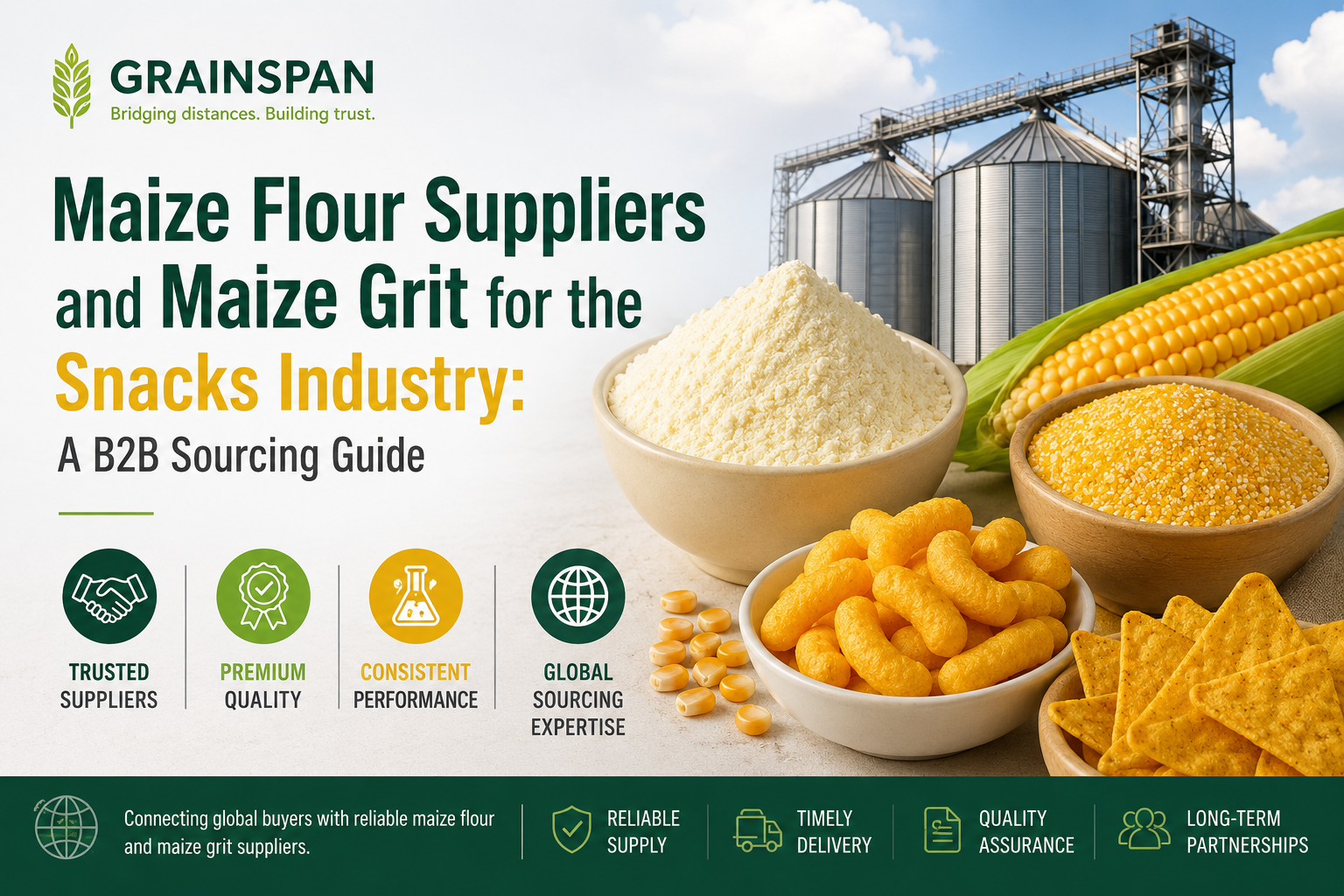
A best maize processing company is, at its core, a food ingredient manufacturer. The food industry’s relationship with corn goes well beyond corn flour on a retail shelf. Industrial corn flour is used in batter coatings for fried food, snack extrudates, bakery mixes, tortillas, and as a wheat flour extender in large-format baking operations. Corn grits are the base ingredient for breakfast cereals, corn flakes, extruded snacks (puffs, rings, tubes), and brewing adjuncts used by beer manufacturers.
The specification requirements differ significantly by application. A snack manufacturer running a twin-screw extruder needs corn grits at a tightly controlled particle size range and moisture – because the expansion ratio and texture of the final product depends on it. A fried chicken coating manufacturer needs fine corn flour at specific granulation and with consistent oil absorption behaviour. These are not commodity purchases; they are ingredient specifications that require a milling partner who understands the downstream process, not just the output of their own.
GrainSpan produces degermed yellow flaking grits, corn grits in multiple granular sizes, corn flour, and pre-gelatinised (alpha) corn flour – which is used in instant food formulations and nutritional products where cold-water dispersibility is required. All of these are produced under FSSAI certification, with ISO 9001, ISO 22000, and FSSC 22000 food safety management systems in place.
The Feed Industry: Where By-Products Become Inputs
One of the most underappreciated aspects of corn dry milling is the feed ingredient value sitting in the by-product streams. The bran and germ fractions that separate out during milling have real nutritional content – fibre, protein, and fat – and go directly into cattle feed and enriched cattle feed formulations.
But the more significant feed co-product story at GrainSpan happens on the ethanol side.
Grain-based animal feed, in the context of a distillery, includes DDGS – distillers dried grains with solubles. DDGS is what remains after corn starch is fermented to ethanol and the liquid is removed. What is left is a protein and fat-rich ingredient running 26-30% crude protein, which makes it a partial substitute for soya meal in poultry and dairy rations, typically used at 5-15% inclusion.
For feed manufacturers sourcing from an integrated corn processing and ethanol company, the advantage is supply chain consolidation. Corn milling by-products and DDGS from the distillery come from the same source, backed by the same quality system, with one point of contact for procurement.
Grain-Based Ethanol Production in Gujarat: How It Works
India’s Ethanol Blending Programme has changed the commercial landscape for grain processors. The shift from molasses-based ethanol (seasonal, tied to sugar mill output) to grain-based ethanol (year-round, using corn and rice) created an opening for dry-milling operations to extend into biofuel production.
GrainSpan was the first grain-based ethanol producer in Gujarat. Our two ethanol plants in Gujarat run at a combined 350 KLPD capacity, and we are actively expanding – with new capacity under commissioning that will increase our total ethanol output significantly once operational.
The process works like this: corn is ground, its starch is liquefied with enzymes, then saccharified (converted from starch chains to fermentable sugars), then fermented with yeast to produce a beer-strength ethanol solution. That solution goes through distillation columns to produce anhydrous ethanol – the high-purity fuel-grade product that oil marketing companies blend with petrol. The whole cycle runs continuously, 24 hours a day, 365 days a year.
The co-products from this process are where the economics get interesting. Besides DDGS, grain-based ethanol production at GrainSpan recovers food-grade CO2 from the fermentation tanks – the same CO2 that beverage manufacturers use for carbonation and that industrial gas buyers use for welding, fire suppression, and cold chain applications. We also recover distilled corn oil (DCO) from the DDGS stream, a refined oil used in food processing and as a biodiesel feedstock.
This co-product stack – ethanol, DDGS, CO2, DCO – is what makes grain-based ethanol production economically resilient. When ethanol procurement prices from OMCs are tightly administered, the co-product revenues provide a partial hedge.
Sustainable Grain Processing: What It Means in Practice
Sustainable grain processing is a phrase that gets used loosely. In a plant context, it means a few specific things:
Full kernel utilisation – every fraction of the corn kernel recovers commercial value, from the endosperm fractions (grits and flour) through the germ (oil or feed) and bran (cattle feed). No significant solid waste stream leaves the plant.
CO2 recovery – instead of venting fermentation CO2 to atmosphere, it is captured, purified, and sold. GrainSpan’s ethanol plants do this as part of normal operations.
Zero liquid discharge (ZLD) – distillery effluent is treated and recycled within the plant rather than discharged. This matters particularly in water-stressed regions like Gujarat.
Energy efficiency – modern grain-based ethanol plants run heat integration between distillation columns, recovering steam from one stage to drive another, which reduces fuel consumption per litre of ethanol produced.
These are operational realities, not aspirational goals. They are also increasingly requirements rather than differentiators – as buyer sustainability audits and regulatory requirements tighten, the processing companies that have built these systems in are better positioned than those who have not.
Choosing the Right Corn Milling and Grain Processing Partner
For food manufacturers, feed companies, and industrial buyers evaluating a corn milling company in India, the decision criteria beyond price are:
Certifications: FSSAI (mandatory), ISO 22000 or FSSC 22000 (food safety management), Halal and Kosher for export to relevant markets. GrainSpan holds all of these, plus APEDA registration for agricultural exports.
Production capacity vs order size: A supplier whose installed capacity is close to your monthly requirement has no buffer for demand variability. Understand utilisation rate and finished goods inventory policy before committing.
Multi-plant geography: A supplier operating across Gujarat, Haryana, and West Bengal can serve buyers across western, northern, and eastern India with reasonable freight economics. Single-plant suppliers carry more concentration risk.
Traceability: Corn procurement traceability to specific sourcing regions matters for food manufacturer supplier audits and for export documentation requirements.
Co-product availability: If you need both food-grade corn ingredients and feed by-products, sourcing from an integrated milling and ethanol company simplifies procurement considerably.
Conclusion
Grain processing in India has evolved well beyond milling flour. The companies doing it well today run integrated operations where the same kernel of corn feeds a food manufacturer, a poultry farmer, a fuel blender, and a beverage company – all from one plant, with nothing going to waste.
GrainSpan Nutrients operates across this full value chain: corn dry milling for food and industrial buyers, rice milling from our Kolkata and Haryana facilities, and grain-based ethanol production in Gujarat with co-product recovery of DDGS, CO2, and DCO. Our facilities hold FSSAI, ISO 9001, ISO 22000, FSSC 22000, Halal, and Kosher certifications, and we export to 19+ countries.
If you are evaluating grain processing partners for food ingredient supply, feed ingredients, or ethanol co-products, contact GrainSpan Nutrients to discuss your requirements.
FAQs
- What is the difference between corn dry milling and wet milling?
Dry milling separates the corn kernel into its fractions – germ, bran, and endosperm – without using water as the processing medium. It produces grits, flour, and feed by-products. Wet milling uses water and chemicals (steeping) to separate starch from protein and fibre more completely, producing purer starch streams. GrainSpan operates dry milling only. Dry milling is more energy-efficient for producing food-grade grits and flour; wet milling produces higher-purity starch but requires significantly more capital and water. - What corn products does GrainSpan supply for the food industry?
GrainSpan supplies degermed yellow flaking grits, corn grits in multiple granular sizes (fine, medium, coarse), corn flour, and pre-gelatinised (alpha) corn flour. These are used across snack manufacturing, breakfast cereal production, batter coating systems, bakery applications, and instant food formulations. - How does grain-based ethanol production in Gujarat work year-round when molasses production is seasonal?
Grain-based ethanol uses corn and broken rice as feedstock – both of which are available 12 months a year from domestic procurement or stored grain. Unlike molasses, which is a seasonal by-product of sugar production available only during the crushing season (roughly 5-6 months), corn can be procured and stored in bulk, allowing continuous distillery operation throughout the year. - What is DDGS and why is it used in animal feed?
DDGS stands for distillers dried grains with solubles. It is the solid co-product remaining after corn starch is fermented to ethanol. It retains the protein, fat, fibre, and yeast from the fermentation process, giving it a crude protein content of 26-30%. It is used in poultry, dairy, and ruminant feed formulations as a partial substitute for soya meal, typically at 5-15% inclusion rates. - What certifications should I look for in a maize processing company in India?
For food-grade supply in India, FSSAI certification is the minimum requirement. For food safety management systems, look for ISO 22000 or FSSC 22000. For export, APEDA registration is required. For supply to GCC or Southeast Asian markets, Halal certification is typically needed. For Jewish dietary law compliance, Kosher certification applies. GrainSpan holds all of these certifications.