
The food manufacturing industry runs on ingredient reliability. A snack line producing 10 tonnes per shift cannot absorb a flour delivery that arrives off-spec on moisture. A breakfast cereal manufacturer running a flaking cooker cannot tolerate grit that varies in particle size batch to batch. Behind every consistent finished food product is a raw material supply chain that performs without drama – and for a large and growing share of India’s food industry, that supply chain starts with maize.
Maize-based ingredients – corn flour, maize grit, degermed flaking grit, and pre-gelatinised corn flour – are now fundamental inputs across bakery, snack manufacturing, breakfast cereal, brewing, and prepared food sectors. As demand for processed food grows both domestically and in export markets, the pressure on maize flour suppliers and corn manufacturers in India to deliver consistent, certified, food-grade material at scale has never been higher.
This guide covers what maize flour is, how it is produced, what quality parameters actually matter in industrial applications, and what food businesses should look for when selecting a corn manufacturer in India as a long-term ingredient partner.
What Is Maize Flour and How Is It Used?
Understanding Maize Flour
Maize flour or corn flour is finely milled corn endosperm – the starchy interior of the maize kernel after the outer bran and germ have been removed. In India, maize flour and corn flour refer to the same product; corn is the North American term for the same grain. Both are produced by the same dry milling process and are used interchangeably in trade and procurement.
The key distinction that separates food-grade maize flour from lower-quality milled corn is degerming – the mechanical removal of the germ before milling. The germ contains 45-50% fat by weight. Leaving it in the flour means higher fat content (4-5% in whole-grain milled vs below 1% in degermed), faster rancidity, shorter shelf life, and inconsistent starch behaviour in downstream food processes. Professional maize flour suppliers and corn milling companies run dedicated degerminators ahead of their milling lines as standard practice.
Maize flour differs from other corn-based ingredients primarily in particle size. Corn grit is coarser – screened to defined size ranges above 0.5 mm – and used where texture and expansion behaviour matter (snack extrusion, cereal flaking). Maize flour is milled finer, typically below 200 microns, and used where smooth texture, coating adhesion, or fine dispersion is required. Pre-gelatinised (alpha) corn flour is a further-processed variant where the starch is heat-treated before regrinding, producing a powder that thickens in cold or warm water without cooking.
Common Food Industry Applications
Maize flour sits across a wider range of food manufacturing applications than most buyers outside the industry realise:
- Bakery products: Corn tortillas, cornbread, gluten-free bread and biscuits, and corn-based flatbreads use degermed maize flour as a primary base. In wheat-based bakery, corn flour is used as an extender and texture modifier.
- Snacks and extruded foods: Fine degermed corn flour forms the base of batter coatings for fried snacks, coatings for namkeen and fried nuts, and components in extruded snack pellet recipes.
- Breakfast cereals: Fine corn flour is used in porridge formulations and as a binder in muesli and granola-type products. Coarser corn grit is the base for corn flake production – but both come from the same dry milling operation.
- Sauces and food preparations: Corn flour is used as a thickening agent in soups, gravies, and sauce bases where a neutral flavour and smooth texture are required.
- Processed food applications: Ready-to-eat meal coatings, batter mixes for frozen food, and institutional food service preparations use corn flour for its consistency, cost efficiency, and availability.
Why Quality Matters When Choosing Maize Flour Suppliers
Consistent Product Quality
For food manufacturers running continuous production lines, raw material consistency is not a preference – it is a production requirement. A corn flour delivery that arrives at 13.5% moisture when your process is calibrated for 12% maximum will change your batter viscosity, affect coating adhesion, and potentially trigger a line adjustment or batch rejection. Consistent product quality from batch to batch, month to month, is the baseline expectation from any serious maize flour supplier.
Food Safety and Hygiene
Food-grade maize flour is a direct food ingredient. The facility that produces it must operate under documented food safety management systems – not just hold a certificate. This means hazard analysis at each processing step, documented cleaning and sanitation protocols, pest control programmes, and batch-level traceability from raw corn procurement through to finished product dispatch. A supplier who can produce these records on request is operating a genuine food safety system. One who cannot is relying on the certificate alone.
Uniform Particle Size and Processing
Particle size uniformity in maize flour directly affects your finished product. In batter coating applications, non-uniform flour produces uneven coating thickness and inconsistent frying behaviour. In extruded snack applications using corn flour as a component, particle size variation changes the dough rheology and the expansion ratio of the final product. Maize processing operations running calibrated plansifters with regular mesh inspection and replacement produce tighter size distributions than mills without this discipline.
Reliable Supply and Production Capacity
A maize flour supplier whose installed capacity is barely larger than your monthly order has no buffer for demand spikes, maintenance shutdowns, or crop procurement challenges. Understand the supplier’s production capacity relative to your requirement, their finished goods inventory policy on standard grades, and their raw material storage depth – all of which determine whether they can sustain supply through the lean procurement months between harvests.
Compliance With Food Industry Standards
Certifications are the starting filter, not the final decision. FSSAI certification is the legal minimum for food-grade maize flour in India. ISO 22000 or FSSC 22000 confirms a documented food safety management system. APEDA registration is required for export. For supply into GCC markets, Halal certification is required. For buyers with gluten-free requirements, confirmation of no wheat cross-contamination in the facility is a separate requirement beyond standard certifications. Always check that certifications are current – not issued years ago and never renewed.
What to Look for in a Corn Manufacturer in India
Modern Corn Milling Facilities
A corn manufacturer in India operating at food-grade standard runs mechanised milling lines – degerminator, roller mills, plansifters, colour sorters – with automated controls rather than manual operation at each stage. The difference shows up in product consistency: mechanised lines hold tighter tolerances on particle size, moisture, and colour than manually operated equivalents. When visiting or auditing a potential supplier, ask specifically about degermination equipment and plansifter configuration – these two stages determine most of the product quality outcome.
Quality Control Across the Production Process
QC at a professional corn milling company runs at multiple points in the process – not just on the finished product. Incoming corn is tested for moisture and aflatoxin before acceptance. Degermed grits are sampled after the degerminator to check germ separation rate. Finished flour is tested for moisture, particle size, fat content, colour, and mycotoxins before dispatch. Ask any potential maize flour supplier for their in-process QC protocol document – not just the finished product CoA.
Consistent Raw Material Sourcing
The quality of finished maize flour starts with the quality of the incoming corn. A corn manufacturer in India with established procurement relationships across multiple growing regions – Karnataka, Andhra Pradesh, Telangana, Madhya Pradesh, Rajasthan – can blend corn from different origins to maintain consistent starch content and quality profile even when one region has a difficult season. Suppliers who buy on the spot market without procurement depth are more exposed to seasonal quality variation.
Scalable Production and Supply
Food businesses grow. A maize flour supplier who can supply 50 MT per month should ideally be able to scale to 200 MT per month as your business grows – without the supply relationship breaking down or pricing becoming punitive at higher volumes. Understand the supplier’s scalability ceiling before committing to a long-term relationship based on current volumes.
Experience Across Food Industry Segments
A corn milling company that has supplied snack manufacturers, breakfast cereal producers, bakeries, and brewers understands how maize flour behaves differently in each application. That application knowledge makes them a better supplier – they understand why you are specifying what you are specifying, can advise when a different grade might perform better in your process, and can catch a potential quality issue before it becomes your problem.
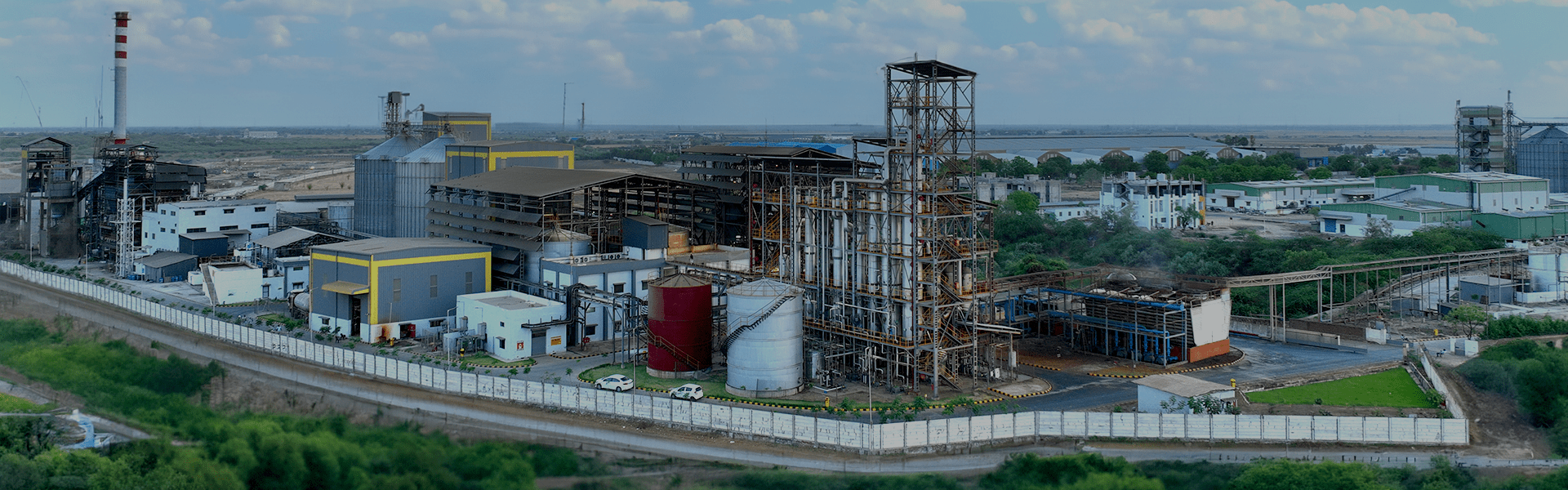
GrainSpan Nutrients supplies corn flour and maize grit to food manufacturers, FMCG brands, and export buyers across India, with milling facilities in Ahmedabad (Gujarat), Gohana – Sonipat (Haryana), and Kolkata (West Bengal).
Understanding the Maize Processing Process
Selection and Cleaning of Corn
Raw corn arriving at the mill is first passed through cleaning equipment – destoners remove stones and heavy foreign material, aspirators remove dust and light chaff, and magnetic separators remove metal particles. The cleaned corn is then tested for moisture and aflatoxin before proceeding to milling. Corn that fails the incoming quality check is rejected rather than processed.
Degermination and Milling
Cleaned corn is tempered with water to reach the optimal moisture for milling – typically 16-18% at the degerminator inlet. Tempering softens the bran and loosens the germ, making separation cleaner. The tempered corn passes through a degerminator that ruptures the kernel and uses the density difference between the lighter germ and the denser endosperm to separate them. Germ separation rate is a key efficiency and quality metric at this stage.
Grinding and Particle Size Control
The degermed endosperm passes through a series of corrugated and smooth roller mill pairs, each reducing particle size progressively. Between each reduction pass, plansifters separate material by particle size – oversize returns for further reduction, in-spec material is extracted at that screen cut. This multi-pass, multi-sift approach produces the tight particle size distributions that food manufacturers require.
Quality Testing and Packaging
Finished maize flour is sampled from the production line and tested for moisture, particle size distribution, fat content, colour (whiteness index), and mycotoxins before packing. Product that meets specification is packed into 25 kg / 50 kg / 500 kg PP woven bags with inner HDPE/LDPE liner, or jumbo bags for bulk buyers, and held in finished goods storage pending dispatch. Product outside specification is held and reviewed – not dispatched and queried later.
Storage and Distribution
Maize flour is moisture-sensitive and should be stored in a cool, dry, covered warehouse away from odour-generating materials. Finished goods stock rotation should follow FIFO (first in, first out) to protect shelf life. For domestic dispatch, truck loading is the standard. For export, container stuffing at or near the plant reduces double-handling and protects packaging integrity.
Food-Grade Corn Flour: Key Quality Considerations
Purity and Cleanliness
Food-grade corn flour should be free from extraneous matter, insect infestation, mould, and off-odours. These are confirmed through visual inspection, sieving for foreign material, and organoleptic (smell and appearance) checks at the finished product stage. A clean, well-run maize processing facility with effective pest control and a documented sanitation programme produces clean product as a matter of routine.
Moisture and Shelf Stability
Maximum moisture for food-grade corn flour is 12-13% under FSSAI standards. Higher moisture reduces shelf life by accelerating microbial activity and creating conditions for mould growth. Degermed corn flour at correct moisture and in sealed bags with an inner LDPE liner has a shelf life of 9-12 months under proper storage conditions. Whole-grain milled flour (germ retained) has a significantly shorter shelf life due to fat oxidation – typically 2-4 months.
Texture and Particle Consistency
Standard degermed maize flour for most food applications runs below 200 microns (approximately 70 mesh). Fine-grind grades run below 100 microns (approximately 150 mesh) for applications requiring smooth texture such as infant cereal, pharmaceutical coating, or confectionery dusting. Confirm the particle size specification – expressed as percentage passing through defined mesh sizes – in your purchase order rather than accepting a nominal grade name without underlying parameters.
Food Safety Controls
Aflatoxin is the primary mycotoxin concern in corn-derived products. FSSAI limits aflatoxin to 20 ppb (parts per billion) in food-grade corn products. Export to EU markets requires compliance with the EU’s tighter limit of 2 ppb for aflatoxin B1 in food. Confirm the supplier’s aflatoxin testing protocol – frequency, testing method (ELISA for screening, HPLC for confirmation), and action threshold when a batch tests above the limit.
Packaging and Storage Requirements
Standard export and food-grade domestic packaging is 25 kg, 50 kg, 500 kg PP woven bags with inner LDPE/HDPE liner. The inner liner provides moisture barrier protection; the outer bag provides mechanical strength during handling. Confirm bag weight rating and liner gauge with your supplier – both vary between manufacturers and affect in-transit protection. For buyers with high-volume requirements, 500-1,000 kg jumbo bags (FIBC) are available from larger corn milling companies.
Corn Products Available for Different Food Applications
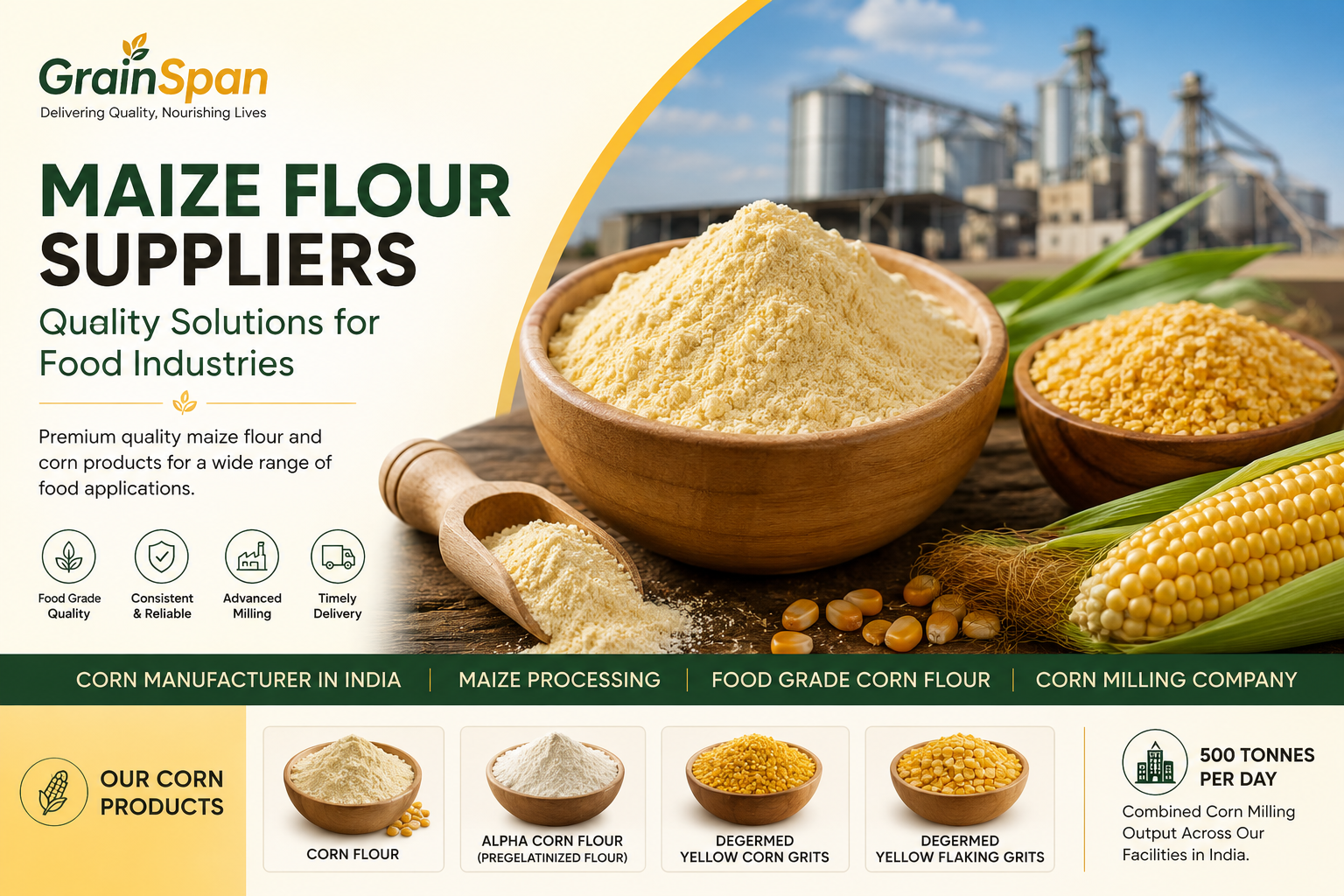
GrainSpan’s corn milling operations produce the following product range for food industry buyers:
Corn Flour
Standard degermed yellow corn flour, milled below 200 microns. Used in batter coatings, flatbreads, corn tortillas, gluten-free baking mixes, and as a wheat flour extender in bakery applications. Available in food-grade 25 kg, 50 kg, 500 kg HDPE bags.
Alpha Corn Flour (Pre-Gelatinised Flour)
Heat-treated corn flour where the starch is gelatinised before regrinding. Disperses and thickens in cold or warm water without cooking. Used in instant soups, weaning cereals, nutritional sachets, meal replacement powders, and pharmaceutical tablet binding. Requires additional processing steps beyond standard milling – available from a limited number of corn manufacturers in India.
Degermed Yellow Corn Grit
Coarsely broken, degermed endosperm screened to specific size ranges. Used in extruded snack manufacturing, breakfast cereal production, brewing adjuncts, and pellet manufacturing. Available in fine, medium, and coarse grades to match downstream process requirements.
Degermed Yellow Flaking Grit
Large, uniform coarse grit specifically sized for corn flake production. Cooked in a pressure cooker, sheeted, and flaked to produce breakfast corn flakes. Tight particle size uniformity is critical – non-uniform flaking grit produces non-uniform flake size in the finished cereal.
Industries That Use Maize-Based Ingredients
Bakery and Confectionery
Corn flour and maize flour are used in gluten-free bakery formulations, corn-based flatbreads, and as wheat flour extenders. In confectionery, fine corn flour is used as a dusting agent on gummy products and as a starch mould material in traditional confectionery manufacture.
Snack Food Manufacturing
The largest industrial consumer of corn grit and maize flour in India. Corn grit is the base ingredient for extruded puffs, rings, and curls. Fine corn flour goes into batter systems for coated fried snacks. Both products require degermed, food-grade material with tight particle size control.
Breakfast Cereals
Degermed yellow corn grit – particularly flaking grit – is the base for corn flake production. Fine corn flour goes into porridge, muesli binding, and fortified breakfast cereal formulations. Consistent starch content and particle size are critical for uniform cooking and flaking behaviour.
Breweries
Corn grit is used as a malt adjunct in beer production – it provides fermentable starch that supplements the malt bill and reduces cost per litre of finished beer. Brewers’ corn grit is assessed on gelatinisation temperature and extract yield rather than food texture parameters.
Sauces and Prepared Foods
Corn flour is used as a thickening and stabilising agent in soups, gravies, sauce bases, and ready-to-eat meal preparations. Pre-gelatinised corn flour is used in instant sauce and soup formulations where cold-water dispersibility is required.
Animal Feed and Pet Food
Corn grit fines and corn flour below food-grade specification are used in compound animal feed and pet food manufacturing as energy-dense carbohydrate sources. Pet food manufacturers using corn ingredients in premium products often specify food-grade degermed material rather than feed-grade for quality positioning reasons.
Benefits of Working With an Experienced Corn Milling Company
Better Product Consistency
An experienced corn milling company has refined its process over years of production – milling parameters, sifter configurations, and QC thresholds are optimised for consistent output. New or small mills are still learning their process; established operations have already solved the problems.
Reliable Bulk Supply
Experienced corn manufacturers in India maintain raw material procurement relationships and finished goods buffer stock that support uninterrupted supply. Seasonal corn procurement challenges, transport disruptions, and demand spikes are managed through inventory depth rather than passed on to the buyer as supply failures.
Application-Specific Corn Products
An experienced corn milling company understands that the right product for a snack extruder is different from the right product for a corn flake line or a brewery. They can advise on grade selection, help troubleshoot process issues tied to ingredient performance, and customise specifications within their production capability when your application requires it.
Quality Assurance
Documented QC at incoming, in-process, and finished product stages – with records available for buyer audit – is the mark of a serious operation. This is not about certification documents; it is about whether the supplier can show you the actual test data when you ask for it.
Long-Term Supply Support
Ingredient supplier relationships in food manufacturing work best over long time horizons. An experienced corn milling company that has supplied the same buyers for years understands their specifications, anticipates their seasonal volume patterns, and resolves issues without escalation. That relationship value is not visible in a first-order price comparison but becomes very clear in the second year of supply.
How to Choose the Right Maize Flour Supplier for Your Business
A practical checklist for food manufacturers evaluating maize flour suppliers:
- Product specifications: Confirm particle size (D50 and mesh pass percentage), moisture maximum, fat content (below 1% for degermed), starch content, and aflatoxin limit in writing – not just a nominal product name.
- Quality certifications and compliance: FSSAI minimum for domestic. ISO 22000 or FSSC 22000 for food safety management. APEDA for export. Halal for GCC markets. Confirm all are current with recent surveillance audits.
- Manufacturing capacity: Installed capacity should be meaningfully larger than your order requirement. Ask for utilisation rate and finished goods inventory policy.
- Product consistency: Request CoA data from five or six consecutive production batches. Tight variance across batches is the real indicator of process control.
- Packaging options: 25 kg, 50 kg, 500 kg bags standard. Jumbo bags for bulk. Custom printed bags for private label. Confirm minimum order quantities for non-standard packaging formats.
- Delivery capabilities: Lead time from order to dispatch for ex-stock material. Logistics network for your geography. Export capability if needed.
- Technical support: Can the supplier advise on grade selection for your application? Do they understand your downstream process? Application knowledge separates a capable supplier from a commodity vendor.
- Industry experience: Ask for references from buyers in the same food segment as your operation. A corn milling company with experience in snack manufacturing is better positioned to supply a snack manufacturer than one whose only experience is in bulk commodity supply.
Why Choose GrainSpan for Corn-Based Ingredients?
GrainSpan Nutrients is a corn manufacturer in India operating three milling facilities – in Ahmedabad (Gujarat), Gohana/Sonepat (Haryana), and Kolkata (West Bengal) – with a combined corn and rice milling capacity of 1,000 MT per day and 75,000 MT of grain storage across our facilities.
Our corn product range covers degermed yellow corn flour, fine-grind corn flour, pre-gelatinised (alpha) corn flour, degermed yellow corn grit in multiple grades, and degermed yellow flaking grit. We supply food manufacturers, FMCG brands, snack producers, breakfast cereal manufacturers, breweries, and export buyers directly from our plants.
Certifications held: FSSAI, ISO 9001, ISO 22000, FSSC 22000, Halal, Kosher, and APEDA registration. We export corn products to 19+ countries.
Explore GrainSpan’s corn and maize flour products for your food manufacturing requirements. Contact us to request product specifications, a sample, or a pricing discussion.
Frequently Asked Questions About Maize Flour Suppliers
- What should I consider when choosing maize flour suppliers?
The key factors are product consistency (confirmed through multiple batch CoAs, not a single certificate), degerming quality (fat content below 1% confirms effective germ removal), production capacity relative to your order volume, current certifications (FSSAI, ISO 22000 or FSSC 22000 at minimum), and the supplier’s experience with your specific food application. Price matters, but a cheaper supplier whose product is inconsistent or whose supply is unreliable costs more in the long run. - What is food-grade corn flour used for?
Food-grade corn flour is used across bakery (gluten-free bread, tortillas, flatbreads), snack manufacturing (batter coatings, extruded snack components), breakfast cereal (porridge, muesli binding, corn flour-based cereals), sauces and gravies (as a thickening agent), instant food formulations (pre-gelatinised grades), and pharmaceutical applications (tablet binding and coating). The specific grade – standard, fine-grind, or pre-gelatinised – depends on the downstream application. - How is maize flour manufactured?
Maize flour is produced by corn dry milling: cleaned corn is tempered with water, passed through a degerminator to separate the germ, and then ground progressively through roller mills. Between each grinding pass, plansifters separate material by particle size. The fraction that meets the target fineness is extracted as corn flour. The remaining coarser fractions become corn grit at different screen cuts. The whole process is monitored with in-process QC checks on moisture and particle size. - What does a corn milling company do?
A corn milling company converts raw maize kernels into food-grade and industrial-grade processed ingredients – corn flour, corn grit in multiple grades, flaking grit, pre-gelatinised flour, and feed-grade by-products (cattle feed, germ meal). The best corn milling companies also manage raw material procurement, quality assurance across the full production process, packaging, storage, and logistics for both domestic and export supply. - Which industries use maize flour?
The main industrial consumers of maize flour in India are snack food manufacturers, bakery and confectionery producers, breakfast cereal manufacturers, brewing companies (who use coarser corn grit as a malt adjunct), prepared food and sauce manufacturers, pharmaceutical companies (pre-gelatinised grades as tablet binders), and animal feed and pet food manufacturers. Export demand comes from food manufacturers in Southeast Asia, the GCC, South Asia, and Africa. - How can I select a reliable corn manufacturer in India?
Start with certifications – FSSAI is the minimum, ISO 22000 or FSSC 22000 confirms a documented food safety system. Then verify manufacturing capacity against your volume requirement. Request CoA data from multiple recent production batches and look for tight variance in moisture, particle size, and fat content. Ask for a plant visit or third-party audit access. Run a sample trial in your process before placing a bulk order. And ask for references from existing buyers in your industry segment – a reliable corn manufacturer in India will have them.