
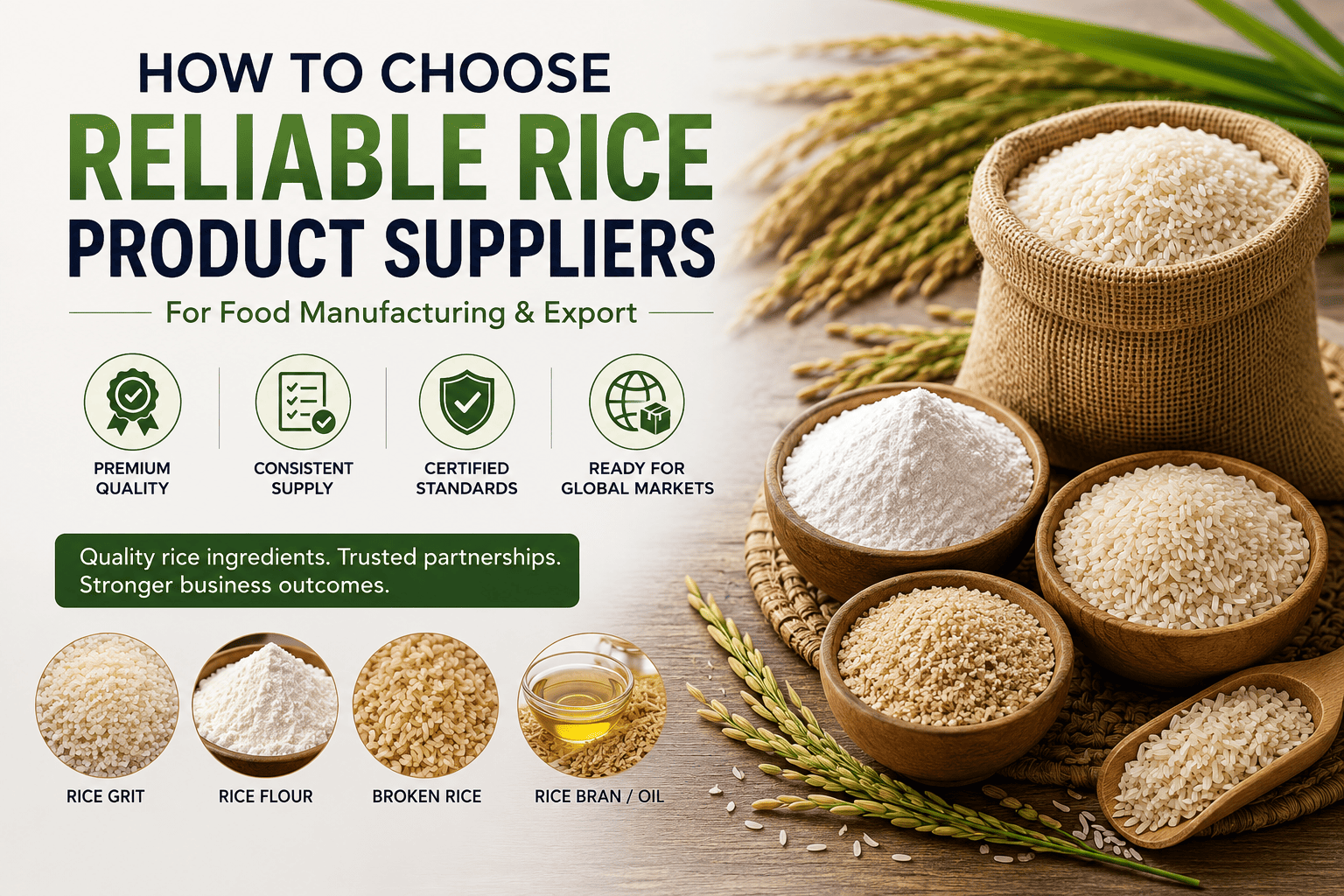
Rice is one of the most processed grains in the world, and the industrial market for rice-derived ingredients is significantly larger than most buyers outside the food industry realise. Rice grit goes into breakfast cereals, weaning food, and snack extrusion. Rice flour goes into gluten-free bakery, batter coatings, baby food, and pharmaceutical manufacturing. Broken rice feeds poultry and goes into bioethanol production. Stabilised rice bran gets converted into a premium edible oil.
For food manufacturers and export businesses, the question is not whether to source from rice product suppliers in India – it is how to identify the ones that can deliver consistently to specification, with the right certifications, at the volumes you need. This guide gives you the framework to do that.
The Rice Product Landscape: What Industrial Buyers Actually Source
Before evaluating suppliers, it helps to be precise about which rice product you need – because “rice product supplier” covers a wide range, and the supply chain for each product category is different.
- Rice grit
Broken, screened endosperm particles in specific size ranges. The primary application is food processing – breakfast cereals, extruded snacks, weaning food, and brewing adjuncts. For aquafeed manufacturers, fine rice grit is used as a binder and energy source in pelleted feed. Rice grit is a volume product with clear specification parameters: particle size distribution, moisture, whiteness index, and broken percentage uniformity. - Rice flour
Finely milled rice below 150-200 microns. Gluten-free, neutral in flavour. Used in batter coatings for fried food, gluten-free baking, rice noodles and vermicelli, baby food and infant cereal, and pharmaceutical tablet binding. Particle size, moisture, and starch gelatinisation behaviour are the key variables. Rice flour suppliers serving infant food or coeliac markets need to confirm inorganic arsenic testing and gluten cross-contamination controls, respectively. - Parboiled rice derivatives
Processed through partial boiling before milling, which gelatinises surface starch, improves nutritional retention, and changes milling behaviour. Parboiled rice grit and parboiled rice flour have different functional properties from raw milled equivalents – confirm whether you need parboiled or raw milled at the specification stage. - Broken rice
Sorted fractured kernels from the whitening and grading steps. Used in animal feed, bioethanol feedstock procurement, and industrial starch processing. High starch content (75-80%), lower cost per tonne than head rice fractions. A volume product primarily serving feed and industrial buyers.
GrainSpan Nutrients operates rice milling facilities across all three of our plants – in Ahmedabad (Gujarat), Gohana (Haryana), and Kolkata (West Bengal) – producing rice grit, rice flour, and broken rice for domestic food manufacturers, feed businesses, and export buyers.
What to Look for in a Rice Product Supplier
- Milling infrastructure and technology
A professional rice processing company runs mechanised hulling, whitening, and grading lines with plansifters for size classification. Colour sorters remove discoloured or damaged kernels. In-line moisture sensing and periodic QC sampling confirm batch quality during production – not just after the fact. The difference between a mechanised mill and a small huller operation shows up in the consistency of the product, not just the headline spec on the CoA. - Parboiling capability
If your application requires parboiled rice products, confirm the supplier has parboiling equipment. Not all rice mills offer this. Parboiling requires a soaking, steaming, and drying sequence that changes the grain’s milling characteristics and nutritional profile – it is not a step that can be retrofitted cheaply. - Storage and procurement
A rice product supplier with significant paddy storage capacity can maintain consistent supply across the seasonal procurement cycle. Paddy availability peaks after harvest (typically October-November for kharif and March-April for rabi depending on the region), and a supplier without buffer stock may struggle to fill orders in the lean months between harvests. GrainSpan’s 75,000 MT storage capacity across our facilities supports year-round supply without seasonal gaps. - Product range breadth
If you source multiple rice-derived ingredients, a supplier who can cover rice grit, rice flour, and broken rice from a single facility simplifies your procurement considerably – one quality system, one supplier audit, one logistics relationship.
Quality Specifications That Matter by Application
For rice grit buyers:
- Particle size distribution (confirm D50 and maximum oversize fraction)
- Moisture (max 13%)
- Whiteness index (relevant for breakfast cereal and weaning food where finished product colour is specified)
- Broken percentage uniformity (tight distribution means consistent cooking behaviour in cereal and snack applications)
- Aflatoxin (max 20 ppb for food applications under FSSAI)
For rice flour buyers:
- Particle size (D50, percentage passing 100 mesh or 200 mesh depending on application)
- Moisture (max 12-13%)
- Protein content (affects functional behaviour in some applications)
- Gluten (below 20 ppm for gluten-free labelling)
- Inorganic arsenic (mandatory for infant food applications; EU limit 0.1 mg/kg)
For export rice product buyers:
- Destination-specific mycotoxin limits (EU limits are tighter than FSSAI domestic limits)
- Phytosanitary compliance
- Packaging and labelling requirements for the destination market
Across all categories – ask for five or six consecutive batch CoAs before committing to a supply contract. A single on-spec CoA tells you that one batch was in spec. Multiple consecutive CoAs tell you whether the supplier’s process is actually under control.
Certifications for Rice Product Suppliers in India
Domestic food supply:
- FSSAI License: mandatory minimum for food-grade rice products
- ISO 22000 or FSSC 22000: food safety management system; increasingly required by large food manufacturers and FMCG groups in supplier qualification
Export supply:
- APEDA Registration: required for agricultural product exports from India
- Phytosanitary Certificate: required by importing countries for grain-based products
- Halal Certification: required for GCC, Malaysia, Indonesia markets
- Kosher Certification: required for certain North American and European buyers
- BRC or FSSC 22000: required for supply into major European retail and food manufacturer supply chains
GrainSpan holds FSSAI, ISO 9001, ISO 22000, FSSC 22000, Halal, Kosher, and APEDA registration. We can provide phytosanitary certificates and certificates of origin for export shipments.
Domestic vs Export: Different Supply Chain Requirements
Domestic food manufacturers sourcing rice ingredients in India are typically looking for consistent quality, reliable truck dispatch, and competitive ex-factory pricing. The documentation requirements are simpler – FSSAI compliance, CoA, and delivery challan.
Export buyers have a different requirement set. Incoterms matter (FOB Kolkata, FOB Mundra, CIF destination). Documentary requirements are detailed – commercial invoice, packing list, bill of lading, certificate of origin, phytosanitary certificate, CoA, fumigation certificate, and destination-specific import certificates. A rice processing company supplying export buyers needs a documentation team that handles all of this routinely, not an export department that scrambles for each shipment.
India is the world’s largest rice exporter by volume. For buyers in Bangladesh, Nepal, the GCC, Southeast Asia, and West Africa, Indian rice product suppliers offer competitive pricing, relatively short shipping distances, and access to a large, diversified milling base. The key differentiator among Indian exporters is not country of origin – it is documentation reliability and supply consistency.
Common Mistakes When Selecting Rice Product Suppliers
- Not specifying parboiled vs raw milled
The two have different functional properties in food applications. Confirm which your process requires before issuing an RFQ. - Evaluating on price without checking capacity
A rice product supplier quoting the lowest price may be doing so on limited capacity that cannot sustain your volume. Understand their installed capacity relative to your monthly requirement. - Skipping the sample trial
Rice products from different mills can vary in whiteness, aroma, cooking behaviour, and texture even when the spec on paper looks identical. Run a process trial with samples before placing a commercial order. - Assuming FSSAI covers all export requirements
It does not. Destination-specific mycotoxin limits, Halal requirements, and packaging labelling rules need to be confirmed separately. Share your destination market’s import requirements with the supplier at the inquiry stage.
GrainSpan Nutrients: Rice Product Supply
GrainSpan Nutrients supplies rice grit, rice flour, and broken rice from our milling facilities in Ahmedabad (Gujarat), Gohana (Haryana), and Kolkata (West Bengal). Our rice milling operations produce to food manufacturer and export buyer specifications, with FSSAI certification, ISO 22000, FSSC 22000, Halal, Kosher, and APEDA registration in place.
Contact GrainSpan Nutrients to discuss your rice ingredient requirement, request a sample, or get a pricing quote for domestic supply or export.
FAQs
- What is the difference between rice grit and rice flour?
Rice grit is coarsely broken and screened endosperm – typically above 200 microns. It is used in breakfast cereals, snack extrusion, weaning food, and brewing. Rice flour is milled finer, usually below 150 microns, and is used in batter coatings, gluten-free baking, noodles, and baby food. Both come from the same raw material; particle size is what separates them. - Do rice product suppliers in India export?
Yes. India is the world’s largest rice exporter and has a well-developed export supply chain for processed rice products including rice grit, rice flour, and broken rice. Export requires APEDA registration, phytosanitary certificates, and destination-specific documentation. GrainSpan Nutrients is APEDA registered and exports rice products to multiple countries. - What is inorganic arsenic in rice and why does it matter for buyers?
Rice naturally accumulates arsenic from soil and water. Inorganic arsenic (the more toxic form) is regulated in infant and baby food specifically – the EU sets a limit of 0.1 mg/kg in processed cereal-based foods for infants. Buyers supplying rice flour or rice grit into infant food formulations must source from suppliers who test for inorganic arsenic and can provide batch-level test results. - Can I source both rice grit and rice flour from the same supplier?
Yes – and it simplifies procurement considerably. GrainSpan Nutrients produces both rice grit and rice flour from the same milling facilities, meaning one supplier qualification, one quality system, and consolidated logistics for buyers who need both products. - What packaging is standard for rice product exports from India?
Standard export packaging is 25 kg PP woven bags with inner LDPE liner, palletised and stretch-wrapped for FCL loading. Jumbo bags (500-1,000 kg) are available for industrial buyers with bulk receiving equipment. Custom-printed packaging is available for branded or private-label supply with sufficient minimum order quantity.