
Corn grit is one of the most widely used cereal ingredients in industrial food manufacturing – and one of the most under-specified. Buyers who know exactly what they need often find it difficult to communicate that precisely to suppliers. Buyers who are less familiar with the product sometimes end up with material that is technically on-spec but performs poorly in their process.
This guide closes that gap. It covers what corn grit is, how it is made, the different grades available, the industries that use it and why, the quality parameters that actually matter, and how to evaluate corn grit suppliers and corn grit manufacturers in India before committing to a commercial relationship.
What Is Corn Grit?
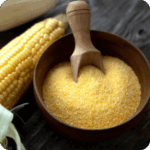
Corn grit (also called maize grit – the terms refer to the same product) is the coarsely broken endosperm of the corn kernel, produced by dry milling and screened to a defined particle size range. It is distinct from corn flour, which is milled finer, and from whole corn meal, which retains the bran and germ alongside the endosperm.
The key production step that separates food-grade corn grit from lower-quality milled corn is degerming. In a professional corn grit manufacturer’s operation, the germ is mechanically separated from the kernel before milling. This reduces fat content in the grit from approximately 4-5% (whole kernel) to below 1% (degermed). Lower fat means longer shelf life, no rancidity risk during storage and transit, and consistent performance in downstream food processes that depend on predictable starch behaviour.
Degermed yellow corn grit is the standard specification for most industrial food applications. If a supplier cannot confirm their degerming rate or provide fat content data across multiple batches, that is a significant flag.
How Corn Grit Is Made
Understanding the milling process helps buyers ask the right questions.
Step 1 – Cleaning: Raw corn is cleaned to remove stones, dust, cobs, and foreign material before entering the mill.
Step 2 – Tempering: The cleaned corn is conditioned with water to reach the optimal moisture for milling – typically 16-18% at the degerminator inlet. Proper tempering loosens the germ and makes separation cleaner.
Step 3 – Degerming: The tempered corn passes through a degerminator (Beall type or similar) that ruptures the kernel and uses density difference to separate the lighter germ from the denser endosperm. Germ separation rate is a key efficiency metric at this stage – a well-run corn grit manufacturer targets above 70% germ separation.
Step 4 – Roller milling: The degermed endosperm (now called pearled grits) passes through corrugated and smooth roller mill pairs to progressively reduce particle size.
Step 5 – Sifting: After each reduction pass, plansifters separate the material by particle size. Oversize goes back for further reduction; material within the target size range is extracted as corn grit at that screen cut.
Step 6 – QC and packing: Finished corn grit is sampled and tested before packing into 25 kg bags, jumbo bags, or bulk dispatch.
Types of Corn Grit: Which Grade for Which Application
Corn grit is not a single product. It is a range, defined by particle size, and the right grade depends entirely on what it is being used for.
- Coarse corn grit (2.0-3.5 mm)
Used in flaking operations for breakfast cereal production (corn flakes). The large, uniform particle size cooks evenly in the flaking cooker and produces consistent flake size and texture. Also used in some traditional food applications and as a brewing adjunct in larger particle formats. - Medium corn grit (1.0-2.0 mm)
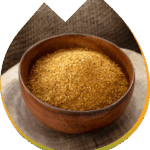
The most widely used grade in snack manufacturing. Forms the base for extruded snacks – puffs, rings, curls, and tubes – and for pellet production. Maize grit in the medium range is also used in corn porridge and certain cereal formulations. This is the grade most buyers mean when they say “corn grit for snacks.” - Fine corn grit (0.5-1.0 mm)
Used in finer-textured extruded products, some weaning food applications, and as a base for certain ethnic food formulations. Also used in brewing where a finer grind gives faster starch extraction. - Brewers’ corn grit
A specific coarse grade produced to brewing industry specifications. Used as a malt adjunct in beer production. Assessed on gelatinisation temperature and extract yield rather than food texture parameters. - Flaking corn grit
Large, uniform coarse grit specifically sized for corn flake production. Typically the most tightly specified in terms of particle size uniformity – because non-uniform flaking grit produces non-uniform flake size, which affects finished product appearance and consumer acceptance.
GrainSpan Nutrients produces degermed yellow corn grit in multiple grades from our milling facilities in Ahmedabad (Gujarat), Gohana (Haryana), and Kolkata (West Bengal). We also produce degermed yellow flaking grit for breakfast cereal manufacturers.
Corn Grit for Snacks: Why Specification Matters
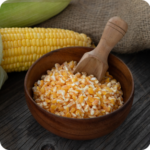
The snack industry is the largest industrial consumer of corn grit in India, and it is also the most specification-sensitive application. Here is why.
Extruded snacks are produced by cooking corn grit under high pressure and temperature inside an extruder barrel, then forcing the cooked mass through a shaped die. As the material exits the die and pressure drops, the moisture flashes to steam and the product expands. The expansion ratio – how much bigger the puffed product is than the extruder die – is what gives corn puffs and rings their characteristic texture.
That expansion ratio is directly influenced by the grit specification:
- Particle size: Grit that is too fine produces over-expansion and a soft, weak structure. Grit that is too coarse under-expands or causes extruder torque problems.
- Moisture: Grit arriving at the extruder above the target moisture changes the steam flash behaviour and alters expansion.
- Starch content: Higher starch means more expansion potential. Degermed grit, with fat removed, also allows more predictable starch behaviour than whole-grain milled material.
- Fat content: Residual fat in non-degermed grit lubricates the screw, reduces shear, and reduces expansion. For snack manufacturers, degermed grit with below 1% fat is not a nice-to-have – it is a process requirement.
For food-grade corn grit suppliers serving snack manufacturers, the ability to hold tight particle size windows batch after batch is the most important capability. A single out-of-spec delivery can require reformulation or extruder adjustment, both of which cost time and money.
Quality Parameters for Food-Grade Corn Grit
When evaluating corn grit suppliers, request CoA data covering:
- Moisture (max 12-13%): Higher moisture reduces shelf life and can cause mould in storage. Specify your maximum and the testing method.
- Particle size distribution: Expressed as percentage retained on defined sieves. Confirm the D10, D50, and D90 (the 10th, 50th, and 90th percentile particle sizes) for precision applications.
- Fat content (max 1% for degermed): Low fat is the marker of effective degerming. Ask for this across multiple batches.
- Starch content (72-75% typical for degermed yellow corn grit): Relevant for applications where starch performance is specified.
- Ash content (max 0.5-1%): Indicates the level of bran contamination in the grit. Higher ash means more bran carry-over from incomplete degerming or sifting.
- Aflatoxin (max 20 ppb for food under FSSAI; 2 ppb B1 for EU export): Ask for the testing protocol – frequency, method, and what happens when a batch exceeds the threshold.
- Whiteness/colour: Measured by whiteness index or L*a*b* values. Relevant for breakfast cereal and branded snack applications where product colour is customer-visible.
Ask for a minimum of five consecutive batch CoAs before placing a commercial order. Tight variance across batches – particularly on particle size and moisture – is the real signal of a reliable corn grits manufacturer.
How to Choose the Right Corn Grit Supplier in India
- Confirm degerming capability first
This is the non-negotiable. Ask for residual fat content data. If a supplier cannot provide it or quotes fat content above 2%, their product is not food-grade degermed corn grit. - Match their capacity to your order
A corn grit supplier whose installed capacity is close to your monthly requirement has no buffer. Ask about utilisation rate, finished goods inventory on standard grades, and how they handle demand spikes. - Check certifications for your market
FSSAI for domestic supply. ISO 22000 or FSSC 22000 for food manufacturer qualification. APEDA registration for export. Halal for GCC and Southeast Asian markets. All should be current with recent surveillance audits – not certificates issued years ago and never renewed. - Run a process trial
Request a 2-5 kg sample of each grade you are evaluating. Run it through your extruder or process equipment under normal operating conditions. Check expansion ratio, texture, and any process anomalies before placing a bulk order. A credible corn grit manufacturer will support this without hesitation. - Ask about raw material sourcing
Indian corn is non-GMO by default. For buyers with non-GMO documentation requirements, confirm this in writing. For buyers concerned about aflatoxin, ask which regions the corn is sourced from – aflatoxin risk varies by geography and season.
GrainSpan Nutrients: Corn Grit Supply
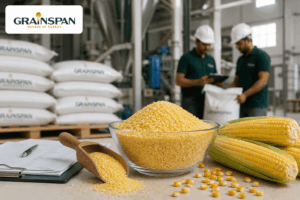
GrainSpan Nutrients is a corn grit manufacturer and maize grit supplier operating from Ahmedabad (Gujarat), Gohana (Haryana), and Kolkata (West Bengal). We produce degermed yellow corn grit in coarse, medium, and fine grades, plus flaking grit for breakfast cereal manufacturers. Combined processing capacity across corn and rice milling is 1,000 MT per day, backed by 75,000 MT of grain storage.
Our certifications include FSSAI, ISO 9001, ISO 22000, FSSC 22000, Halal, Kosher, and APEDA registration. We supply snack manufacturers, cereal producers, brewing companies, and export buyers, and we export corn grit to 19+ countries.
Contact GrainSpan Nutrients to request a sample, product data sheet, or bulk pricing for your corn grit requirement.
FAQs
- What is the difference between corn grit and corn flour?
Corn grit is coarsely screened degermed endosperm, typically above 0.5 mm in particle size. Corn flour is milled finer, below 200 microns, and is used where a smooth texture or fine coating is required. Both are produced from the same degermed endosperm in the corn milling process; the difference is how many times the material passes through reduction rolls and how fine the final sifting cut is. - What particle size of corn grit is best for extruded snacks?
For most twin-screw extruder snack applications, medium corn grit in the 0.8-1.5 mm range works well. Single-screw extruders may need slightly coarser material. The optimal size depends on your specific extruder type, screw configuration, and die design – confirm with your equipment manufacturer before specifying the grit grade for a new product. - Is Indian corn grit non-GMO?
Yes. India does not commercially cultivate genetically modified corn, so all domestically grown and processed corn grit from India is non-GMO by default. For buyers requiring formal non-GMO documentation for labelling or regulatory purposes, GrainSpan can provide a supplier declaration confirming Indian-origin non-GMO corn as the input material. - What is degermed corn grit and why is it preferred for food use?
Degermed corn grit has had the germ – the fat-rich embryo of the kernel – mechanically removed before milling. This reduces fat content from 4-5% in whole-kernel corn to below 1% in degermed grit. Lower fat means longer shelf life (9-12 months vs 2-4 months for whole-grain milled), no rancidity risk, and more consistent starch behaviour in food processing applications. Virtually all industrial food applications specify degermed corn grit. - How do I evaluate a corn grit manufacturer in India before placing a bulk order?
Request batch CoA data from five or six consecutive production runs and check for tight variance in moisture, particle size, and fat content. Ask for fat content data specifically – it confirms degerming quality. Request a 2-5 kg sample for a process trial in your own equipment. Verify certifications are current. Ask about installed capacity relative to your monthly volume. And if possible, arrange a plant visit or third-party audit before signing a supply agreement.