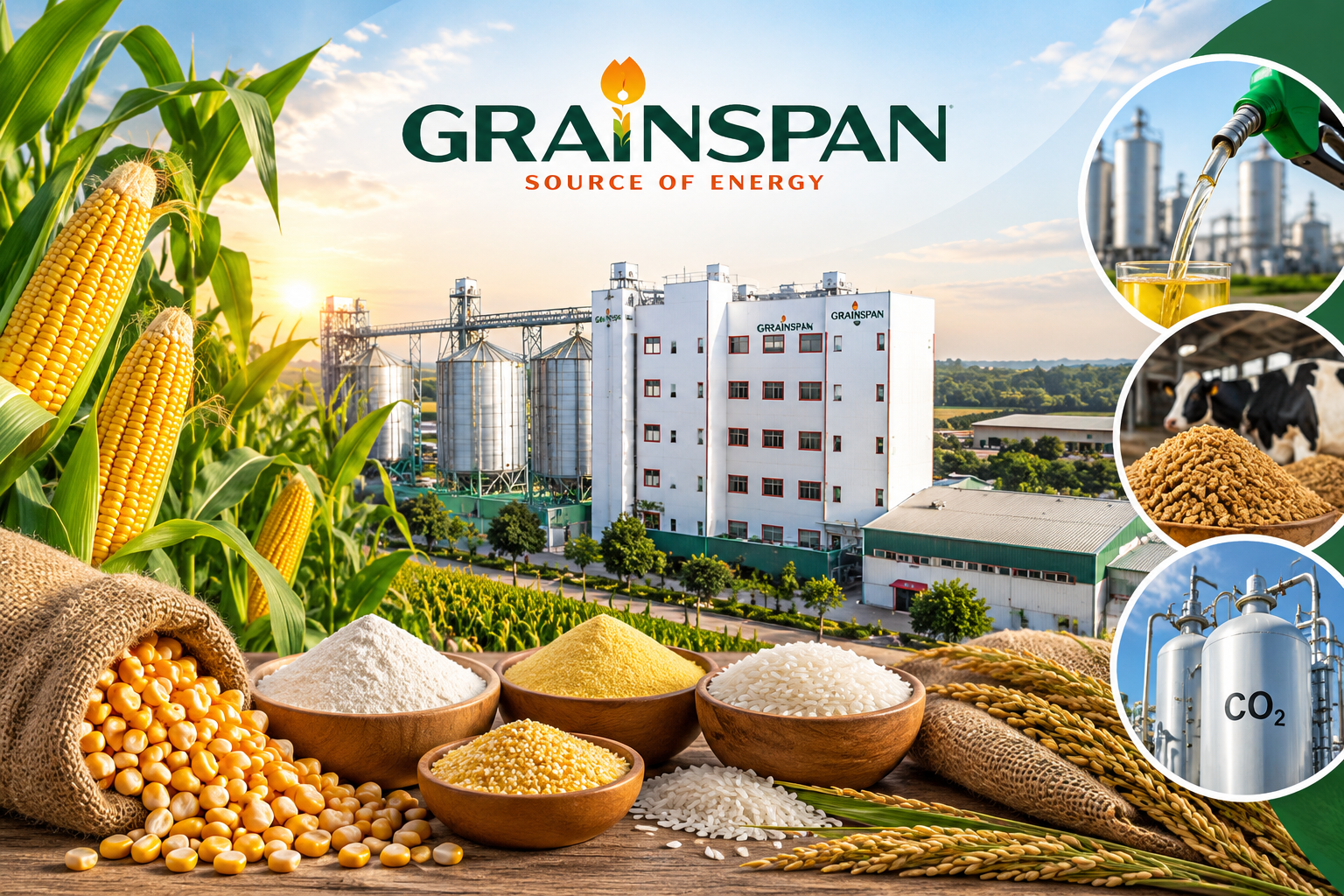

Most people understand that corn can be milled into flour. Fewer realise that the same grain, run through a different process, produces fuel for your car, protein for a dairy cow, gas for a soft drink, and cooking oil – all from one kernel, in one integrated plant.
That is what grain-based ethanol production in Gujarat looks like when it is running at industrial scale. The ethanol gets the headlines because it goes into petrol. But the co-products – DDGS, food-grade CO₂, and distillers’ corn oil (DCO) – are what make the economics work and what a growing number of bulk buyers across feed, food, and industrial sectors are actively sourcing.
This article explains what each co-product is, how it is produced, who buys it, and why sourcing from an integrated grain processor rather than a standalone supplier changes the reliability equation.
How Grain-Based Ethanol Production Works
The starting point is starch. Corn is the primary feedstock for grain-based ethanol production in Gujarat – it is available year-round (unlike molasses, which is seasonal), stores well, and converts efficiently to ethanol through enzymatic processing.
The process runs in stages. First, the corn is ground to expose the starch. Enzymes are added to liquefy the starch at high temperature, then a second enzyme converts the liquefied starch into fermentable sugars. Yeast is pitched into this sugar solution and ferments it over 48-72 hours, producing a beer-strength liquid at roughly 10-12% ethanol by volume.
That liquid goes through a series of distillation columns that separate the ethanol from water and solids, concentrating it to 95% ethanol. A molecular sieve dehydration unit removes the remaining water to produce anhydrous ethanol at 99.9% purity – the fuel-grade product that oil marketing companies require for petrol blending.
What remains after distillation – the whole stillage – is not waste. It is the starting point for the co-product stream.
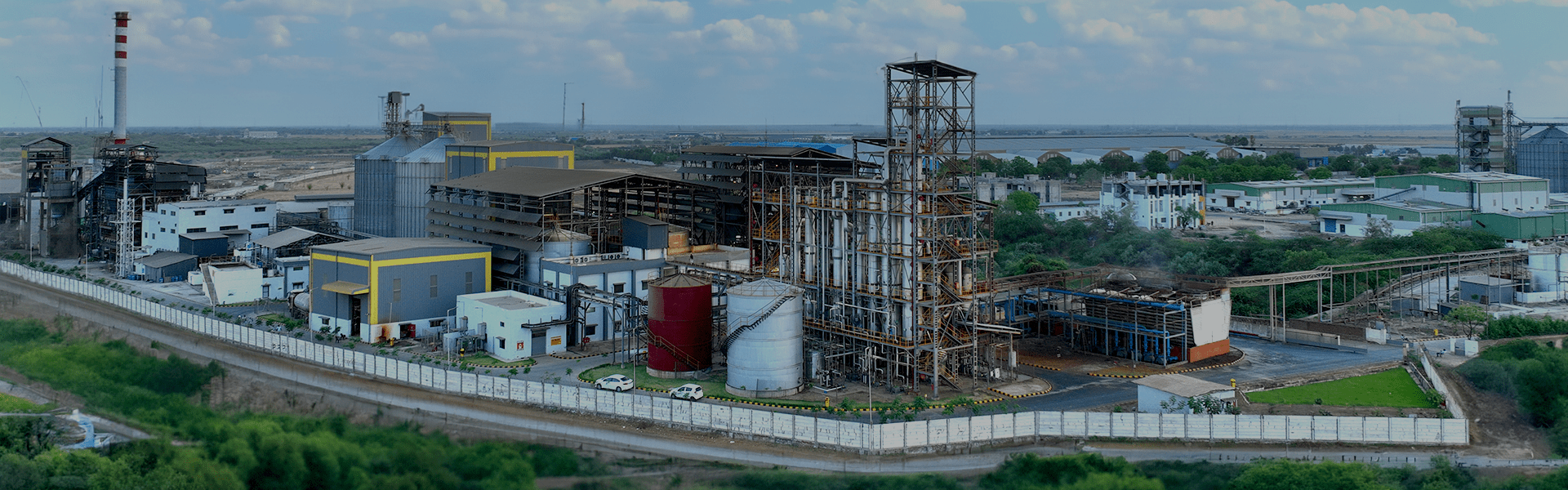
GrainSpan operates grain-based ethanol production across two plants in Gujarat at a combined 350 KLPD capacity, supplying OMCs under fixed contracts as part of India’s Ethanol Blending Programme. We are among the largest grain-based ethanol producers in Gujarat and were the first grain-based distillery to operate in the state.
DDGS: Grain-Based Animal Feed from the Distillery
After distillation, the whole stillage is centrifuged to separate the wet cake (solids) from the thin stillage (liquid). The thin stillage is evaporated into a syrup called solubles. The wet cake and solubles are then combined and dried in a rotary drum dryer to produce DDGS – distillers dried grains with solubles.
DDGS is the highest-volume co-product from a grain-based ethanol plant. It is also the most nutritionally significant.
Because the fermentation process consumes only the starch in the corn – leaving protein, fat, fibre, and yeast behind and concentrated – DDGS ends up with roughly three times the protein concentration of the original corn. Typical specifications run 26-30% crude protein, 8-12% fat, and 2,400-2,600 kcal/kg of metabolisable energy. That nutritional profile puts it directly in competition with soya meal as an ingredient in compound feed formulations.
For bulk DDGS suppliers serving the Indian feed market, the commercial case is straightforward: DDGS typically prices at a 30-40% discount to soya meal on a protein-equivalent basis. Poultry integrators, dairy feed manufacturers, and aquafeed producers use it at 5-15% inclusion to partially replace soya while maintaining nutritional targets. At scale, the cost saving per tonne of finished feed is meaningful.
The parameters buyers should specify when sourcing from bulk DDGS suppliers are: crude protein (minimum 26%), moisture (maximum 12%), fat content (affects energy value and storage stability), sulphur (elevated sulphur indicates poor processing quality), and aflatoxin (should be below 20 ppb for poultry, 50 ppb for cattle under Indian standards).
GrainSpan supplies DDGS from our Gujarat ethanol plants directly to feed manufacturers, dairy cooperatives, and poultry integrators. As grain-based animal feed co-products go, DDGS is among the most consistent in nutritional profile when produced from a dedicated corn-fed distillery – which is what we run.
Food-Grade CO₂: From Fermentation Byproduct to Beverage Input
Fermentation produces CO₂ as a natural by-product of yeast metabolism. For every tonne of ethanol produced, a grain-based distillery generates approximately 0.76 tonnes of CO₂. At 350 KLPD capacity, that adds up to a substantial volume daily.
At smaller or less sophisticated operations, this CO₂ is vented to the atmosphere – a waste of a commercially valuable gas and an unnecessary emission. At GrainSpan, it is captured, purified, compressed, and sold as food-grade CO₂.
Food-grade CO₂ from a grain-based ethanol plant undergoes multi-stage purification – scrubbing, activated carbon treatment, and distillation – to remove fermentation-derived impurities and reach the purity levels required for food and beverage contact. The finished product meets the same specifications as CO₂ from any other food-grade source.
The buyer base for CO₂ from distilleries is broad. Beverage manufacturers use it for carbonation in soft drinks, beer, and sparkling water. Food processors use it for modified atmosphere packaging (MAP), which extends shelf life in packaged meat, produce, and dairy without preservatives. Industrial gas buyers use CO₂ for welding, fire suppression systems, and pH control in water treatment. Cold chain operators use liquid CO₂ for blast freezing and dry ice production.
For CO₂ suppliers for beverages specifically, the relevant certification is food-grade purity compliance – typically tested against ISBT (International Society of Beverage Technologists) standards or equivalent. Buyers should ask for purity certificates and impurity profiles on a batch basis, not just a one-time qualification test.
The advantage of sourcing CO₂ from an integrated grain processor like GrainSpan – rather than a standalone gas supplier – is supply continuity. Our CO₂ production is a direct function of ethanol production, which runs 365 days a year. There is no seasonality, no planned shutdown risk tied to a third-party feedstock, and no single-plant concentration risk.
DCO: Distillers’ Corn Oil and Its Commercial Applications
Distillers’ corn oil, or DCO, is recovered from the thin stillage stream during DDGS production. After centrifugation, the thin stillage contains residual corn oil that was present in the germ fraction of the original grain. This oil is recovered through a secondary centrifuge step and sold as crude or refined DCO.
DCO is not the same as refined corn oil produced by solvent extraction from the germ in a dry-milling plant – though the source grain is the same. DCO has a different fatty acid profile and higher free fatty acid content than food-grade refined corn oil, which affects its applications.
The primary markets for DCO are:
- Biodiesel and renewable diesel: DCO is a preferred feedstock for biodiesel and hydrotreated vegetable oil (HVO) production because its high free fatty acid content makes it cheaper to process than refined oils and its carbon intensity score qualifies it for advanced biofuel classifications in several regulatory frameworks.
- Animal feed fat supplement: DCO is used as an energy supplement in poultry and swine feed, added at 1-3% inclusion as a fat source. Its energy density (approximately 8,500 kcal/kg) and cost relative to refined vegetable oils make it a cost-effective feed fat.
- Industrial lubricants and oleochemicals: Certain DCO grades are used in industrial applications where refined food-grade oil is not required.
For DCO suppliers, the key specification parameters buyers check are: free fatty acid content (FFA%), moisture and impurities (M&I), and fatty acid profile. Biodiesel producers have specific FFA tolerance limits; feed applications are less restrictive.
GrainSpan supplies DCO from our Gujarat ethanol operations. As a co-product of continuous grain-based ethanol production, DCO supply is consistent and not subject to the seasonal swings that affect crude vegetable oil markets.
Why the Co-Product Stack Matters
The four outputs from GrainSpan’s grain-based ethanol production – ethanol, DDGS, CO₂, and DCO – are not independent products. They are produced simultaneously from the same corn input, on the same plant, under the same quality system.
For buyers, this has a practical implication: a supplier whose co-product economics are healthy runs a more stable business than one whose entire revenue depends on the OMC ethanol procurement price. When the administered ethanol price is tight, DDGS, CO₂, and DCO revenues partially offset the margin compression. That financial stability translates directly into supply reliability for buyers on all four product streams.
This is what sustainable grain processing looks like in practice – not just environmental credentials, but a business model where nothing is wasted, and every output stream contributes to the plant’s long-term viability.
For bulk DDGS suppliers, CO₂ suppliers for beverages, and DCO suppliers operating in India, the integration question is worth asking: does your supplier produce these as primary products with dedicated investment, or as afterthoughts from a plant designed for something else? At GrainSpan, all four streams are engineered into the plant design from the start.
Conclusion
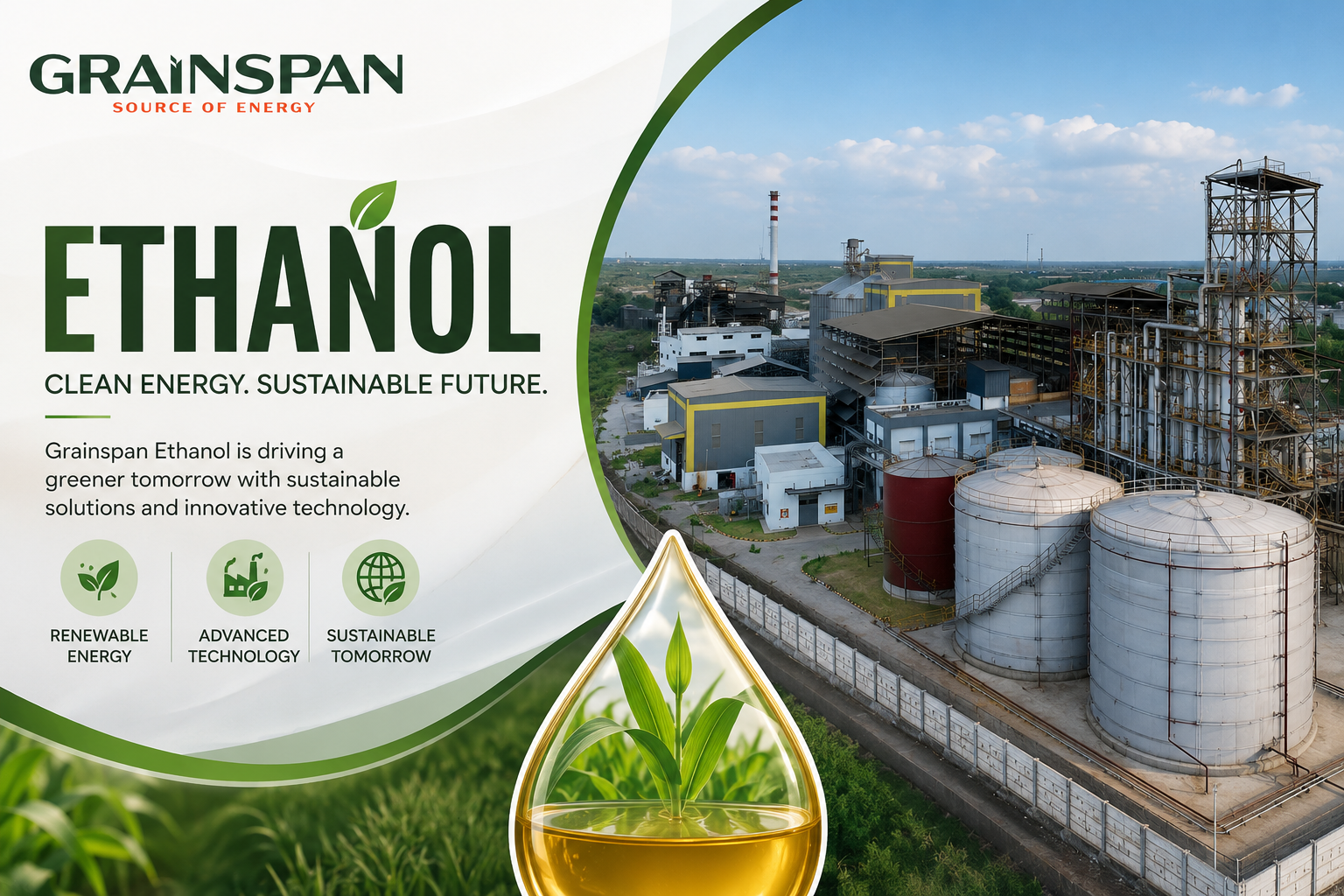
Grain-based ethanol production in Gujarat is no longer just about fuel. The co-product revenues from DDGS, food-grade CO₂, and DCO are increasingly central to what makes an integrated grain processor commercially viable – and increasingly central to what buyers in feed, beverage, and industrial sectors are actively looking for in a supply partner.
GrainSpan Nutrients operates grain-based ethanol production at 350 KLPD combined capacity in Gujarat, supplying OMCs under fixed contracts and co-products to feed manufacturers, beverage companies, biodiesel producers, and industrial gas buyers. We are actively expanding our ethanol capacity.
Contact GrainSpan Nutrients to discuss bulk supply of DDGS, food-grade CO₂, DCO, or ethanol co-products from our Gujarat operations.
FAQs
- What is DDGS and why is it used as animal feed?
DDGS stands for distillers dried grains with solubles. It is the solid co-product remaining after corn starch is fermented to ethanol. Fermentation consumes only the starch, leaving protein, fat, fibre, and yeast concentrated in the residual material. At 26-30% crude protein, DDGS partially replaces soya meal in poultry, dairy, and ruminant feed at 5-15% inclusion – typically at 30-40% lower cost per unit of protein. - Is CO₂ from ethanol production safe for food and beverage use?
Yes, provided it undergoes proper purification. CO₂ from fermentation contains trace impurities from the fermentation process that must be removed before food contact use. GrainSpan’s CO₂ goes through multi-stage purification including scrubbing, activated carbon treatment, and distillation to meet food-grade purity specifications. Buyers should request batch purity certificates and impurity profiles confirming compliance with ISBT or equivalent standards. - What is DCO and how is it different from refined corn oil?
DCO (distillers corn oil) is recovered from the thin stillage stream during DDGS production. It has higher free fatty acid content than refined corn oil produced by solvent extraction from the germ, which makes it less suitable for direct food use but preferred for biodiesel production, renewable diesel, and feed fat applications. It is priced below refined corn oil but above most other industrial fats, reflecting its quality and carbon intensity credentials. - Why source DDGS from a dedicated grain-based distillery rather than a molasses-based plant?
Grain-based distilleries produce DDGS from corn, which gives a consistent protein and energy profile year-round. Molasses-based plants do not produce DDGS – their by-product is spent wash, which has different feed applications and lower protein content. If your feed formulation calls for DDGS specifically, it must come from a grain-based ethanol plant. - What certifications should bulk DDGS and CO₂ buyers look for?
For DDGS as a feed ingredient, check FSSAI compliance, ISO 9001 or ISO 22000 at the producing facility, and mycotoxin testing protocols. For food-grade CO₂, the producing facility should hold FSSAI certification and the CO₂ should be tested against ISBT standards or equivalent food-grade purity benchmarks. APEDA registration is required if either product is being exported from India.