
India’s grain-processing industry is entering a new phase.
Corn and rice are no longer being viewed only as traditional food grains. They are increasingly part of a wider industrial ecosystem that connects food ingredients, animal nutrition, renewable fuel, biofuel and value-added agricultural products.
For businesses sourcing grain products from India, this shift creates both opportunities and new considerations.
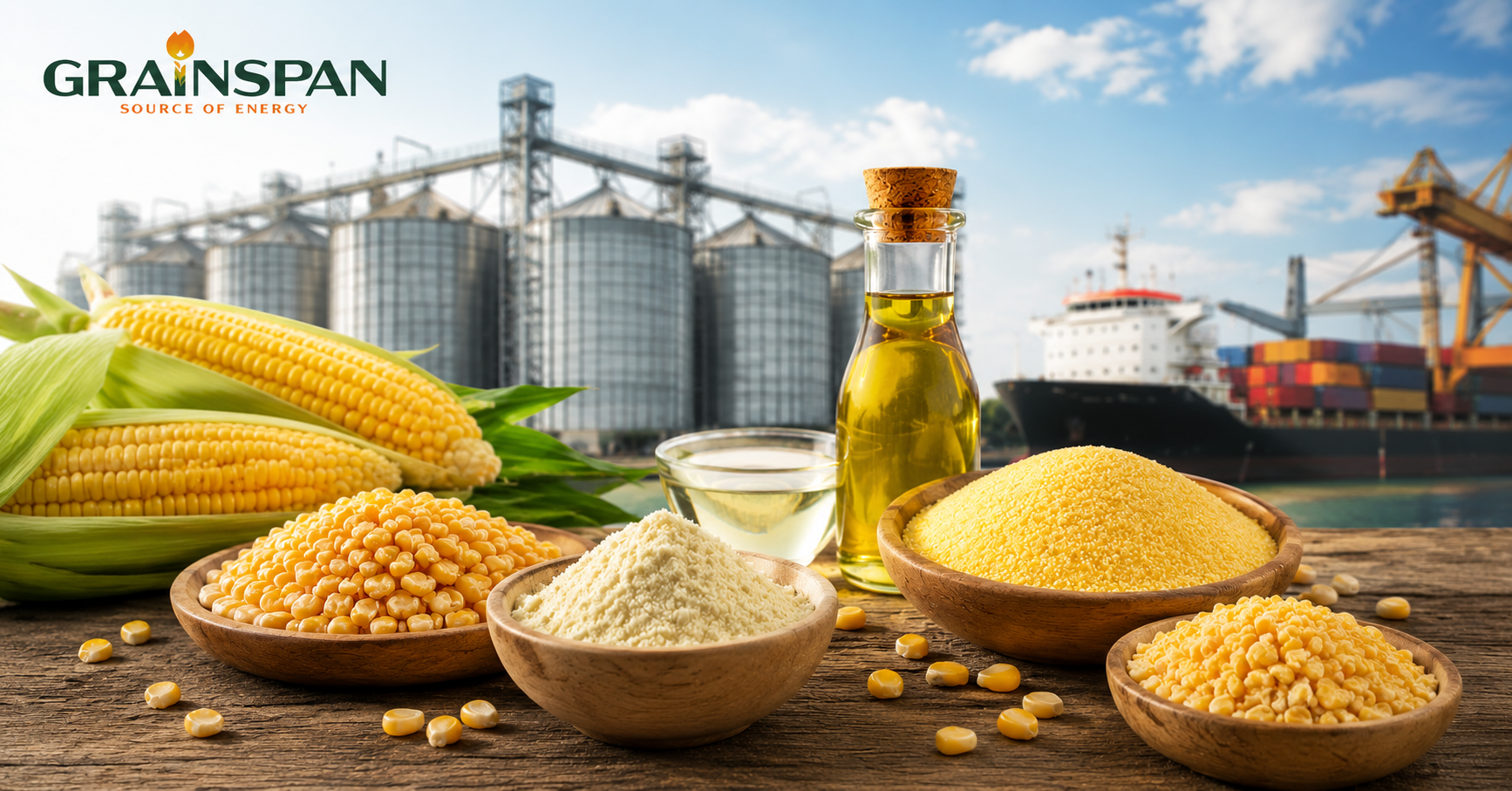
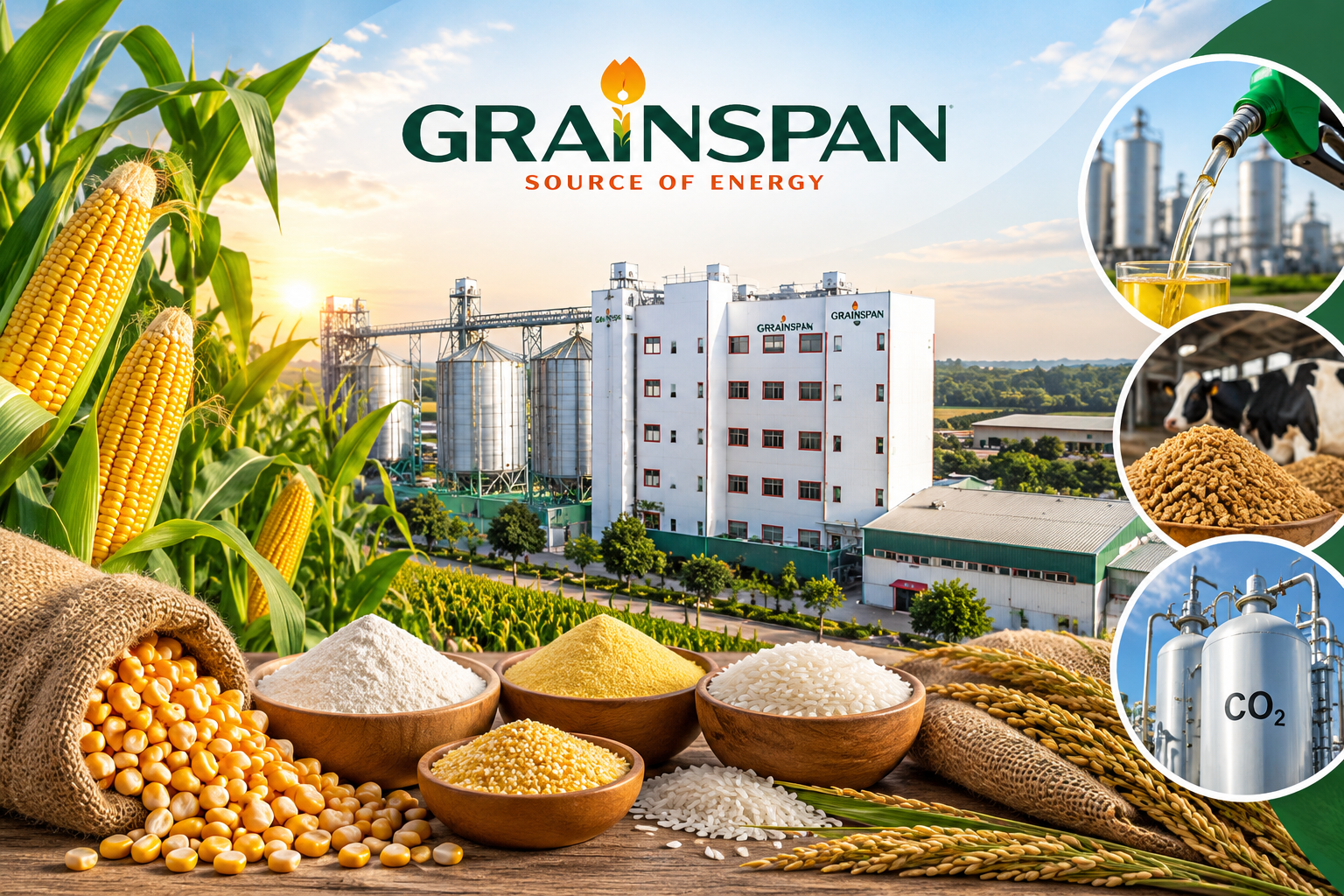
A modern corn milling company in India may serve food manufacturers with corn flour and grits, while the same broader grain-processing ecosystem can support ethanol production, DDGS for animal feed and recovery of CO₂ from fermentation.
At the same time, India’s growing ethanol programme is changing maize demand. Government data shows that India achieved 20% ethanol blending in petrol during ESY 2025–26, while grain-based ethanol capacity has expanded substantially.
This means the future of grain processing is increasingly about extracting more value from every tonne of agricultural raw material.
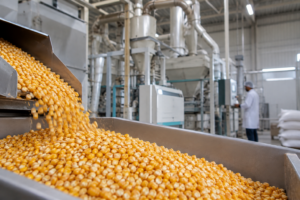 India’s Grain Processing Industry Is Becoming More Integrated
Traditional grain processing generally focused on producing food products from agricultural grains.
Today, the value chain is becoming broader.
A single grain such as maize can potentially move through different processing routes depending on market demand:
Maize → Milling → Food Ingredients
or
Maize → Fermentation → Ethanol + DDGS + CO₂
Rice can also play multiple roles, including food applications and use as a feedstock for grain-based ethanol.
This integrated model is becoming particularly important because demand for grain is coming from several industries simultaneously.
Food manufacturers need processed ingredients.
Feed manufacturers need protein and energy sources.
The biofuel industry needs suitable feedstock.
International buyers need consistent grain-derived products.
The result is a more interconnected grain-processing market.
Why Maize Is Becoming One of India’s Most Important Processing Grains
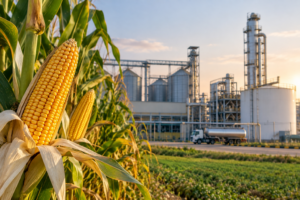 Maize has traditionally been important for food and animal feed.
But ethanol has added another major demand driver.
Recent market intelligence indicates that maize used for ethanol production in India has been rising rapidly, with APEDA reporting projected maize diversion of about 12.8 million tonnes for ethanol in ESY 2025–26, compared with 7.6 million tonnes in ESY 2023–24.
The Economic Survey also highlights the changing economics of maize, noting substantial improvement in maize yields over the past decade and the growing influence of ethanol demand on agricultural incentives.
For grain processors, this creates an important market shift.
Maize is no longer simply a raw material for flour, grits and feed.
It is increasingly a multi-industry commodity.
What Does a Corn Milling Company in India Actually Produce?
A modern corn milling operation can produce different maize-derived products depending on the processing technology and customer requirements.
These may include:
- Corn flour
- Maize flour
- Corn grits
- Other milled maize fractions
- Products used in food manufacturing
- Grain suitable for further processing
The exact specifications can vary according to the application.
For example, a snack manufacturer may need a particular grade of corn grits, while another food manufacturer may require finely milled maize flour.
That is why industrial buyers should not select a corn milling company in India only on the basis of price.
The more important questions are:
Can the manufacturer maintain consistent specifications?
Can it supply the required volume?
Does it have appropriate storage and quality-control infrastructure?
Can it support long-term domestic or international supply?
Corn Flour and Maize Flour: What Are Buyers Looking For?
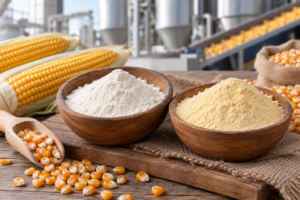
The terms corn flour and maize flour are often used interchangeably depending on the market.
Both refer to milled maize products, although actual specifications can vary.
Food manufacturers may use these products in:
- Snacks
- Bakery products
- Breakfast foods
- Extruded products
- Traditional food applications
- Processed-food formulations
For businesses searching for corn flour suppliers in India, the key issue is consistency.
A buyer may require a particular particle size, moisture level, packaging format and production volume.
A reliable manufacturer should therefore be able to discuss the technical requirements before supplying the product.
This is particularly important for international buyers, where product specifications may need to remain consistent across repeated shipments.
Corn Grits: A Growing Opportunity in Food Processing
Corn grits are another important maize-derived product.
They are produced by milling maize into coarser particles and are widely relevant to food manufacturing applications.
Depending on the specification, corn grits can be used in snacks, cereals, extruded products and other processed foods.
Businesses sometimes search for corn grits machine manufacturers in India when they actually need a finished-product supplier.
These are two different requirements.
A machinery manufacturer supplies processing equipment.
A grain-processing company supplies the finished corn grits.
For food manufacturers, ingredient distributors and bulk buyers, understanding this distinction can save considerable time during procurement.
Rice Milling Is Also Moving Beyond Traditional Processing
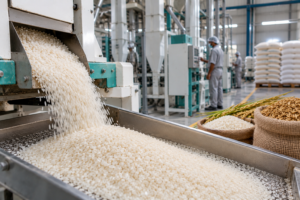 Rice remains one of India’s most important agricultural commodities, but its role in the processing economy is becoming broader.
Professional rice milling services can convert raw rice into products suitable for food and industrial applications through controlled cleaning, milling, separation and grading.
For manufacturers, the value of a rice-processing partner is not simply the ability to mill grain.
It is the ability to consistently deliver the required specification.
This includes:
- Raw-material quality
- Moisture control
- Milling performance
- Product consistency
- Storage
- Packaging
- Logistics
- Supply continuity
For international customers, export documentation and logistics capabilities also become important.
The Biggest Market Change: Grain-Based Ethanol
Perhaps the most significant recent development in India’s grain-processing industry is the rapid expansion of grain-based ethanol.
India’s ethanol-blending programme has transformed the demand landscape.
The government originally targeted 20% ethanol blending for 2030 and later advanced the target to ESY 2025–26. India subsequently achieved the 20% blending level during ESY 2025–26.
This has increased the importance of grain-based ethanol manufacturers.
Government data indicates that India’s total ethanol production capacity reached about 1,953 crore litres by October 2025, including approximately 980 crore litres from grain-based distilleries.
This is a major structural change for the grain industry.
Why Maize Matters to Ethanol Manufacturers in India
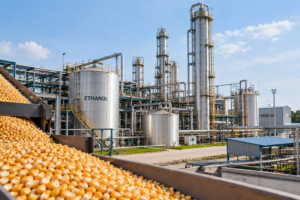 Maize has emerged as an important feedstock for India’s ethanol industry.
Government policy has encouraged the production of fuel-grade ethanol from maize and other grains, while recent market data shows increasing maize allocation toward ethanol production.
For ethanol manufacturers in India, access to reliable feedstock has therefore become an important part of the business model.
The relationship works in both directions.
Ethanol creates additional demand for maize.
Maize processing creates valuable co-products.
And those co-products can support other industries.
This leads to one of the most important trends in modern grain processing:
The grain is no longer being valued only for its primary product.
From Ethanol to DDGS: Creating Another Revenue Stream
One of the most interesting developments in grain-based ethanol is the growing importance of DDGS.
DDGS stands for Dried Distillers Grains with Solubles.
It is a co-product of grain-based ethanol production that retains valuable nutrients from the original grain.
After starch is used for ethanol production, the remaining material contains components such as protein, fibre, fat and minerals.
It can then be processed and dried for use in animal nutrition.
This creates a powerful connection:
Maize → Ethanol + DDGS
Instead of considering the residual material as waste, modern processing can turn it into another commercial product.
DDGS Suppliers in India and the Animal Feed Market
The demand for DDGS is closely connected with India’s growing animal-feed industry.
Recent APEDA market intelligence cited industry estimates of DDGS supply to India’s animal-feed sector increasing from approximately 3.2 million tonnes in 2024–25 to a projected 4.2 million tonnes in 2025–26.
This is an important development for businesses looking for DDGS suppliers in India.
DDGS can provide a source of protein, energy and other nutrients in animal-feed formulations, although its appropriate inclusion depends on animal species, feed formulation and product specifications.
For buyers, important considerations include:
- Protein content
- Moisture
- Fibre
- Fat
- Nutritional consistency
- Storage stability
- Product quality
- Supply reliability
As India’s grain-based ethanol industry grows, DDGS is likely to become an increasingly important part of the country’s feed-ingredient market.
Grain-Based Animal Feed and the Emerging Circular Model
The connection between ethanol and animal feed illustrates a broader trend.
Instead of looking at grain processing as a single-product operation, manufacturers are increasingly looking at the complete value chain.
A simplified example is:
Grain
↓
Starch Conversion
↓
Ethanol
↓
DDGS
↓
Animal Feed
This creates multiple economic outputs from the same agricultural input.
It can also reduce the amount of material treated as waste.
For feed manufacturers, this creates another domestic source of feed ingredients.
For ethanol manufacturers, it creates an additional value stream.
And for the overall grain industry, it supports greater resource utilisation.
CO₂ Recovery: Another Product from the Ethanol Process
There is another part of the ethanol process that is receiving increasing attention: carbon dioxide recovery.
CO₂ is naturally generated during fermentation.
Instead of releasing all of it, suitable ethanol facilities can capture, purify and prepare CO₂ for commercial applications.
This creates another connection:
Grain → Ethanol + DDGS + CO₂
Captured CO₂ can have applications in areas such as beverage carbonation, food processing and certain industrial processes, subject to appropriate purity and regulatory requirements.
This is why the conversation around CO₂ production companies is increasingly connected with modern biofuel manufacturing.
The New Focus: Sustainable Grain Processing
Sustainability in grain processing is becoming less about a single environmental initiative and more about how efficiently the entire raw material is utilised.
A modern integrated facility can potentially create several outputs from the same grain.
For example:
Corn
→ Food ingredients
→ Ethanol
→ DDGS
→ Captured CO₂
This approach can help manufacturers improve resource utilisation while creating additional value from agricultural commodities.
The concept is particularly relevant as businesses and governments look for ways to combine food production, renewable energy and circular resource use.
India’s biofuel programme itself is increasingly linked with energy security, domestic feedstock utilisation and reduced dependence on imported fossil fuels. Government figures indicate that ethanol blending has already generated significant foreign-exchange savings and reduced crude-oil requirements.
What Is Driving the Future of India’s Grain Processing Market?
Several trends are likely to influence the industry over the coming years.
1. Continued demand for grain-based ethanol
India has already achieved the 20% blending milestone, and the ethanol ecosystem has developed substantial production capacity.
The next phase will likely focus more heavily on efficiency, feedstock flexibility, plant utilisation and sustainable production.
2. Growing competition for maize
Maize is being demanded by multiple industries at the same time.
It is required for:
- Animal feed
- Food processing
- Starch and industrial applications
- Ethanol
- Export markets
APEDA’s market intelligence already identifies ethanol as a major demand driver for maize.
For processors, this makes efficient procurement and supply-chain management increasingly important.
3. Expansion of DDGS as a feed ingredient
As grain-based ethanol production grows, DDGS availability also increases.
This creates an opportunity for India’s animal-feed sector to incorporate more domestically produced grain-based feed ingredients.
4. Greater emphasis on value-added processing
Selling raw agricultural commodities provides one level of value.
Processing those commodities into specialised food, feed, energy and industrial products creates additional value.
This is likely to encourage further investment in:
- Milling
- Fermentation
- Drying
- Separation
- Co-product recovery
- Storage
- Quality-control systems
5. More integrated manufacturing
The strongest grain-processing businesses may increasingly be those that can connect multiple parts of the value chain.
Instead of:
Grain → One Product
the model is increasingly becoming:
Grain → Multiple Products → Multiple Markets
That is an important competitive advantage for manufacturers serving food, feed, energy and international markets.
What Should Buyers Look for in a Grain Processing Company?
Whether you are searching for corn product exporters, rice product suppliers, corn flour suppliers in India, maize flour suppliers or ethanol manufacturers in India, the buying decision should go beyond the product name.
Look for a manufacturer that can demonstrate:
Consistent quality
Products should meet defined specifications across batches.
Production capacity
The supplier should be capable of handling your expected volumes.
Modern processing
Processing technology influences product consistency and efficiency.
Storage infrastructure
Adequate storage can support continuity of supply.
Quality control
Testing and process controls are essential for industrial and food applications.
Supply-chain capability
Reliable transportation and logistics matter just as much as manufacturing.
Export readiness
International customers need appropriate documentation, packaging and shipping capabilities.
Long-term scalability
A good supplier should be able to grow with the buyer’s requirements.
Why Indian Grain Manufacturers Are Becoming More Relevant Globally
India is already a major agricultural producer, but its opportunity increasingly lies in moving further up the value chain.
Instead of exporting or supplying only raw grains, the country can increasingly serve global markets with:
- Processed maize products
- Corn flour
- Corn grits
- Rice-derived products
- Feed ingredients
- DDGS
- Ethanol
- Other value-added grain products
This creates opportunities for Indian manufacturers that combine agricultural sourcing, processing expertise, quality management and international supply capabilities.
For global buyers, this can mean accessing a broader range of grain-derived products through Indian manufacturing partners.
GrainSpan: Building an Integrated Grain Processing Business
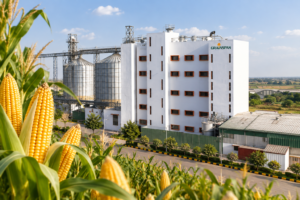 GrainSpan operates within this changing grain-processing landscape with capabilities spanning corn milling, rice milling, grain-based ethanol and value-added co-products.
The company’s approach reflects the broader direction of the industry: using agricultural grains not simply as raw materials for one product, but as inputs for multiple markets.
Its capabilities are relevant to businesses operating across:
- Food manufacturing
- Food ingredients
- Animal nutrition
- Biofuel
- Industrial applications
- International grain-product sourcing
For buyers, this integrated approach can simplify sourcing by connecting multiple grain-processing requirements with a manufacturing partner.
Who Can Benefit from Working with a Grain Processing Manufacturer?
Grain-processing manufacturers can support a wide range of B2B customers.
Food manufacturers
For corn flour, maize flour, corn grits and other grain-derived ingredients.
Feed manufacturers
For DDGS and other grain-based animal-feed ingredients.
Biofuel businesses
For grain-based ethanol and related supply requirements.
Beverage and industrial users
For suitable recovered and purified CO₂ applications.
Distributors and importers
For consistent bulk supply of grain-derived products.
International procurement teams
For sourcing processed corn and rice products from India.
The key is matching the right product specification with the right manufacturing capability.
Frequently Asked Questions
What is a corn milling company in India?
A corn milling company processes maize into products such as corn flour, maize flour and corn grits for food, ingredient and industrial applications. Modern processors may also operate connected grain-processing and ethanol facilities.
Who are the leading corn flour suppliers in India?
Corn flour is supplied by various grain mills and food-ingredient manufacturers across India. Buyers should evaluate suppliers based on product specifications, quality systems, manufacturing capacity and supply reliability rather than relying only on price.
What is the difference between corn flour and corn grits?
Corn flour is generally finely milled maize, while corn grits are coarser particles. The appropriate product depends on the buyer’s manufacturing application.
Why is maize important for ethanol production in India?
Maize has become an important ethanol feedstock as India expands grain-based ethanol production. Recent market data shows a substantial increase in maize allocation toward ethanol.
What is DDGS?
DDGS means Dried Distillers Grains with Solubles. It is a co-product of grain-based ethanol production and is commonly used as an ingredient in animal-feed formulations.
Why is DDGS becoming important in India?
Growing grain-based ethanol production is increasing domestic DDGS availability, while India’s feed industry provides a large potential market for the product. Recent industry estimates indicate rising DDGS availability for animal feed.
How is grain-based ethanol produced?
Grain is milled and its starch is converted into fermentable sugars. These sugars undergo fermentation, followed by distillation and dehydration to produce ethanol. The process can also generate DDGS and CO₂.
What are grain-based animal-feed products?
Grain-based feed products include ingredients derived from grains or grain-processing operations. DDGS is one example and can contribute protein and energy to animal-feed formulations.
What should I check when choosing maize flour suppliers?
Check particle size, moisture, quality controls, production capacity, packaging, storage, logistics and the manufacturer’s ability to provide consistent supply.
Are corn product exporters the same as corn manufacturers?
Not necessarily. Some exporters manufacture their own products, while others source products from third-party manufacturers. For long-term B2B sourcing, understanding who actually manufactures the product can help buyers assess quality and supply reliability.
What are the latest trends in India’s grain-processing industry?
The major trends include increasing grain-based ethanol production, rising maize demand from ethanol, growing DDGS availability for animal feed, greater utilisation of grain-processing co-products, improved maize productivity and increasing emphasis on integrated and sustainable processing.
The Future of Grain Processing Is About More Than Milling
India’s grain-processing industry is moving toward a more integrated model.
Corn is becoming food, feed and fuel.
Rice is becoming more than a traditional food commodity.
Ethanol is creating new demand for agricultural feedstocks.
DDGS is connecting biofuel production with animal nutrition.
CO₂ recovery is creating another potential value stream.
And behind all of these developments is one larger opportunity:
Getting more value from every grain.
For businesses looking for corn milling, rice milling, corn flour, maize flour, corn grits, DDGS, grain-based ethanol or other grain-derived products, choosing an experienced manufacturing partner is becoming increasingly important.
GrainSpan’s integrated approach to grain processing places it within this evolving Indian and global market, connecting agricultural raw materials with food, feed, biofuel and industrial applications.
For product specifications, bulk requirements or global sourcing opportunities, connect with GrainSpan and discuss your grain-processing requirements with the team.