
Corn flour suppliers in India are not hard to find. Reliable ones are. A snack line or bakery needs flour that arrives at the same moisture, particle size and colour every time, and the gap between a supplier who manages that and one who does not only shows up after you have signed. Demand for maize-based food ingredients keeps rising with packaged snacks, cereals and gluten-free products, so more buyers are asking how to choose maize flour suppliers who deliver month after month.
This guide covers how corn flour is made, how it differs from corn grit, where it is used, and what to check before you pick a supplier.
Looking for corn flour or corn grit in bulk? Contact GrainSpan for specifications and samples.
What Is Maize Flour and How Is It Produced?
Maize flour is finely milled corn endosperm. Corn flour and maize flour are the same product, and the name just follows regional habit. In the UK, “cornflour” usually means corn starch, a different ingredient, so for international orders specify by parameters, not by name.
At GrainSpan’s plants the route runs like this. Corn is stored, cleaned and tempered. A degerminator then peels the bran coat and germ off the endosperm and splits the material into two streams: tail stock (the larger endosperm pieces) and thru stock (hull, germ and smaller endosperm).
The thru stock goes through a dryer and cooler, then a gravity table where density separates germ from endosperm. After reduction rolls and a sifter, it becomes corn flour and alpha corn flour. The tail stock goes through its own dryer and cooler, then an aspirator that uses air flow to lift away lighter bran, then a sifter. That stream gives flaking grits, corn grit and cattle feed.
Difference Between Corn Flour, Maize Flour and Corn Grit
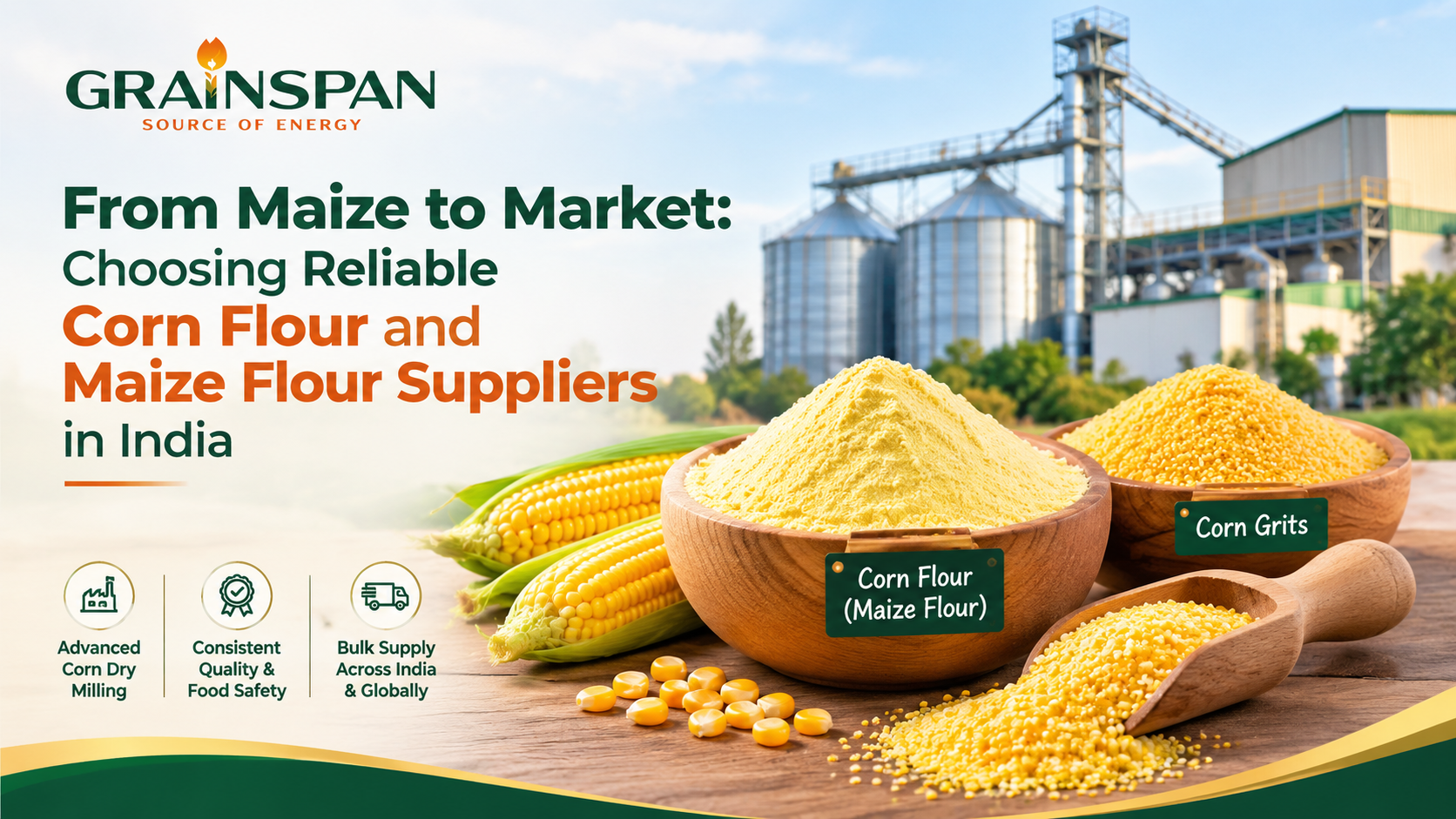
- Corn flour / maize flour: fine, degermed endosperm for batters, bakery and food formulations.
- Alpha corn flour: pre-gelatinised flour that thickens in water without full cooking, used in instant and ready-to-cook foods.
- Corn grit and flaking grits: coarser pieces sold by granular size, used for extruded snacks, cereals and brewing.
Since these come from different streams in the mill, corn grit is not simply a coarser version of flour. A supplier who runs both streams well gives you more sourcing options from one relationship.
Applications of Maize Flour in Snacks, Bakery and Food Manufacturing
- Snacks: batter and coating systems, plus corn grit as the base for extruded snacks
- Bakery: flatbreads, tortillas, cornbread, and as a partial wheat flour replacement
- Soups, sauces and instant foods: alpha corn flour for thickening and cold-water dispersion
- Breakfast cereals: flaking grits for corn flakes, flour for porridge-style products
- Brewing: corn grit as an adjunct
What to Check Before Choosing Corn Flour Suppliers in India
- Manufacturer or trader: ask for plant details and batch traceability. Manufacturers can show production records, while traders cannot.
- Degermed product: confirm the flour is degermed and ask for fat content on the CoA.
- CoA data across batches: moisture, particle size distribution, ash, colour and aflatoxin. Request five or six consecutive batches, not one.
- Certifications: FSSAI as the minimum, plus ISO 22000 or FSSC 22000. Add APEDA for export, and Halal or Kosher where your market needs them.
- Capacity: installed capacity should sit comfortably above your monthly volume.
- Sample trial: run it on your own line before a commercial order.
Why Milling Technology and Product Consistency Matter
Each stage of the process controls something specific. Tempering affects how cleanly the germ comes away. The gravity table separates germ from endosperm by density. Sifting sets particle size. Skip or rush one and the flour you receive drifts from the flour you approved.
When you audit a supplier, ask them to walk you through their flow in this order. Vague answers are worth noting.
Packaging, Quality Standards and Bulk Supply Considerations
Ask what pack formats are available, from standard bags to bulk bags, and whether bags are lined against moisture. Specify the formats in your purchase order along with the testing method for each parameter. Flour should be stored dry, away from strong odours, and used first-in, first-out. For bulk contracts, confirm lead time on ex-stock grades and how the supplier handles demand spikes.
Need a dependable corn flour supplier? Talk to GrainSpan about bulk supply and delivery terms.
Corn Flour Supply from GrainSpan
GrainSpan runs corn dry milling at three plants, in Ahmedabad (Gujarat), Gohana (Haryana) and Kolkata (West Bengal), with combined corn and rice capacity of 1,000 MT per day and 75,000 MT of storage. The range covers corn flour, alpha corn flour, corn grit in multiple granular sizes and degermed yellow flaking grits, plus cattle feed. Certifications include FSSAI, ISO 9001, ISO 22000, FSSC 22000, TQMI, Halal, Kosher and APEDA, and we export to 19+ countries.
FAQs About Maize Flour and Corn Grit
Is corn flour the same as maize flour?
Yes. They are the same product. Always specify particle size, moisture and fat limits in the order.
What is the difference between corn flour and corn grit?
Flour is fine and used for coatings, bakery and formulations. Corn grit is coarser and sold by granular size for snacks, cereals and brewing. In GrainSpan’s mills they come from different process streams.
What is alpha corn flour?
Pre-gelatinised corn flour that thickens in water without full cooking, used in instant and ready-to-cook foods.
What should I check on a corn flour CoA?
Moisture, particle size distribution, fat, ash, colour and aflatoxin, ideally across several consecutive batches.
Does GrainSpan supply corn flour for export?
Yes. GrainSpan is APEDA-registered and exports to 19+ countries. Send us your specification and destination for a quote.
Request a sample or product specification sheet from GrainSpan.