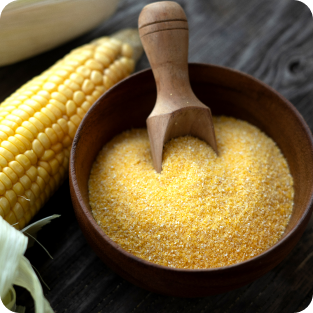


Corn grits have quietly become one of the more useful outputs of India’s maize processing industry. Coarse, shelf-stable, and versatile, they show up in snack extruders, brewery mash tuns, breakfast cereal lines, and animal feed rations – often without much fanfare about where they came from or how they were made.
India’s position as a corn grits supplier has strengthened over the last decade. Domestic maize output has grown consistently, processing infrastructure has expanded, and Indian manufacturers now supply both the local food industry and export markets across Southeast Asia, the Middle East, and Africa. The global corn grits market has grown at roughly 5% annually, and Indian manufacturers are picking up a growing share of that demand.
For buyers – whether you’re sourcing for a snack manufacturing line, a brewery, or an animal feed operation – the challenge is not finding suppliers. It’s finding the right one.
What Are Corn Grits?
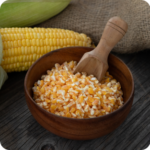
Corn grits are the coarse, degermed particles of the maize endosperm – the starchy interior of the kernel, separated from the germ and bran during milling. The germ carries most of the fat, so removing it extends shelf life and makes the product suitable for high-temperature processing like extrusion.
Yellow corn grits are the most widely produced in India, made from yellow maize varieties. The colour carries through into finished products – relevant for snack manufacturers where visual consistency matters.
White corn grits come from white maize and are used where a neutral colour is required – certain breakfast cereals, bakery applications, and some brewing adjuncts.
Flaking grits are a specific grade – larger particle size, conditioned to a precise moisture level – used by breakfast cereal manufacturers to produce corn flakes. The particle size tolerance for flaking grits is tighter than for standard food-grade grits, and not every mill produces them consistently.
The manufacturing process follows a standard sequence: raw maize is cleaned to remove dust, stones, and foreign matter; the kernel is conditioned with moisture to toughen the germ and make separation cleaner; a degermer separates the germ from the endosperm; roller mills break the endosperm into grits; plansifters classify the output by particle size; aspirators remove residual bran. Each step affects the final product. Degerming efficiency in particular determines fat content in the grits, which directly affects shelf life and extrusion behaviour.
Applications of Corn Grits
Snack manufacturing is the largest domestic end-use. Extruded snacks – puffed corn rings, corn chips, cheese puffs, and similar formats – are made by forcing hydrated corn grits through a die under pressure and heat. The particle size distribution and moisture content of the grits determine how the product expands, its texture, and its density. Snack manufacturers typically have tight grit specifications and test incoming material for moisture, particle size, and fat content.
Brewing uses corn grits as an adjunct grain alongside malted barley. The grits contribute fermentable starch and dilute the protein content of the mash, producing a lighter beer with a cleaner flavour profile. Breweries require grits with specific gelatinisation characteristics and low fat content – over 12% fat in grits can cause foam stability problems in the finished beer.
Breakfast cereals – cornflakes in particular – use flaking grits as the primary input. The grits are cooked, pressed into flakes, and toasted. Particle size consistency and low fat content are critical; off-spec grits produce uneven flakes that break during processing.
Bakery and food manufacturing use finer corn grits and corn semolina in flatbreads, porridge, baby food, and instant mixes. Corn grits add texture, extend flour blends, and contribute a mild flavour that works across sweet and savoury applications.
Animal feed absorbs coarser grits fractions and bran that don’t meet food-grade specifications. Poultry and cattle rations use maize-based ingredients as energy sources, and corn grits by-products fit naturally into that formulation space.
Top Corn Grits Manufacturers in India
India’s corn grits manufacturing base is concentrated in maize-producing states, with Gujarat, Maharashtra, Karnataka, and Uttar Pradesh hosting the largest operations. The list below covers established manufacturers with documented supply capability.
Grainspan Nutrients is a Gujarat-based grain milling and ethanol operation supplying corn grits alongside other maize-milled products. With production units across Gujarat, Haryana, and West Bengal, Grainspan supplies food manufacturers, feed compounders, and industrial buyers with batch-documented, FSSAI-compliant corn grits.
Godawari Industries is one of the larger export-oriented corn grits manufacturers in India, supplying food-grade yellow and white grits to international markets. Their operation is set up for bulk export with documentation support for overseas buyers.
TBI Corn Limited runs an automated corn processing plant with high throughput capacity. Their grits are used across the snack and food manufacturing sectors, and they have the infrastructure for consistent large-volume supply.
Mittal Cornezza focuses on customised grit sizes for food-grade applications, supplying snack manufacturers and cereal producers who need particle size specifications beyond standard grades.
Shree Salasar Balaji Enterprise is an export-oriented supplier with supply capability across grit grades. They serve both domestic food manufacturers and international buyers.
Jaydeep Industries is a Gujarat-based manufacturer supplying corn grits to food processing and feed industries, with road and rail logistics connectivity to major markets.
Key Manufacturing Hubs in India
Gujarat is India’s most significant corn grits processing hub. The state’s combination of maize procurement connectivity, port access for export, and established food processing infrastructure has made it the default origin for both domestic and international buyers. Ahmedabad, Rajkot, and Vadodara have the highest density of active suppliers.
Maharashtra has a large maize-growing belt in Marathwada and Vidarbha that supports local processing operations. Pune and Nashik have food-grade processing facilities serving the western India market.
Karnataka and Andhra Pradesh are major maize-producing states with processing capacity concentrated near Davangere, Bellary, and Kurnool. Buyers sourcing for southern India markets will find shorter logistics distances from these origins.
Delhi-NCR functions more as a trading and distribution hub than a manufacturing base, but several processors with plants in adjacent states – Haryana, Uttar Pradesh, Rajasthan – dispatch through Delhi for northern India distribution.
How to Choose the Right Corn Grits Manufacturer
Certifications. FSSAI registration is the baseline for any food-grade corn grits supplier in India. For export or regulated food manufacturing applications, ISO 22000 or FSSC 22000 indicates more systematic food safety management. HACCP certification is relevant for buyers supplying to international food brands with supplier audit requirements.
Production capacity and throughput consistency. Installed capacity on paper and actual reliable throughput are different numbers. Ask for average daily production figures, not peak capacity, and ask about downtime frequency. A plant rated at 200 TPD running at 60% utilisation is a different supply relationship than one running steadily at 85%.
Granulation consistency. Particle size distribution needs to hold across batches, not just within a single delivery. Ask for COAs from multiple batches across different months. Wide variation in particle size between batches is a sign of equipment wear or inconsistent process control.
Export capability. If you’re sourcing for re-export or need phytosanitary certificates, fumigation documentation, or specific packaging for overseas shipment, check whether the supplier has handled this before. Not all domestic manufacturers are set up for export documentation.
Packaging options. Standard 50kg PP bags work for most domestic buyers. Bulk bags, custom labelling, or specific packaging formats for retail or food service channels require a supplier with more flexible packaging infrastructure.
MOQ and pricing structure. Minimum order quantities vary significantly between manufacturers. Some will supply from 5 MT; others require 50 MT or more to take an order. Understand the pricing structure – whether it’s flat per tonne or tiered by volume – before comparing quotes.
Corn Grits Price in India – What Drives the Number
Corn grits pricing in India moves with several variables, and a single published rate is rarely a reliable guide for what you’ll actually pay.
Raw maize prices are the primary input cost and the biggest source of price movement. Maize procurement is seasonal – prices typically soften post-harvest (October – December in most states) and firm up in the lean season before the next crop arrives. Buyers who can time procurement or commit to forward volumes tend to get more stable pricing.
Processing technology and yield. Mills running modern degerming and milling equipment produce higher endosperm recovery per tonne of raw maize, which gives them more room for price. Older equipment with lower recovery rates passes that inefficiency through to product cost.
Quality grade. Food-grade grits with tight particle size, low fat content, and full FSSAI documentation are priced above feed-grade or off-spec material. The gap is not always large, but it’s real.
Order volume and commitment. Buyers committing to monthly volumes – even informally with a known supplier – typically access better pricing than spot purchasers. Processors running continuous operations prefer predictable offtake over ad hoc orders.
For current rates, direct inquiry with shortlisted suppliers is more useful than any published index. Prices can shift meaningfully within a quarter based on maize procurement costs.
Why Source Corn Grits from Indian Manufacturers
Input cost advantage. India’s domestic maize production has grown to over 35 million MT annually. Local procurement keeps raw material costs lower than in markets dependent on imported grain, which flows through to competitive ex-works pricing for buyers.
Quality and export standards. The expansion of food-grade corn grits exports from India has pushed manufacturers toward better documentation, testing, and traceability practices. FSSAI regulation, combined with international buyer requirements, has raised the baseline quality standard across established manufacturers.
Supply chain depth. India has multiple maize-producing states with different harvest timings, which smooths seasonal supply disruptions. A Gujarat-based processor can supplement procurement from Karnataka or UP if local availability tightens.
Logistics infrastructure. Rail and road connectivity from major maize-processing hubs to ports – JNPT in Mumbai, Mundra and Pipavav in Gujarat – supports cost-effective export logistics for international buyers.
Export Potential of Corn Grits from India
Indian corn grits are exported to markets across Southeast Asia, the Middle East, Africa, and parts of Europe. The primary demand is from food manufacturers and snack producers in markets where local maize processing capacity is limited or costs are higher.
Key export destinations include Indonesia, Malaysia, Vietnam, the UAE, Saudi Arabia, Kenya, and Nigeria – markets with growing packaged food industries and established import infrastructure for agri-processed products.
India’s competitive position in corn grits export rests on price, availability, and improving quality documentation. As food safety standards in importing countries tighten, the gap between well-certified Indian manufacturers and commodity traders is widening in favour of the former.
Future of the Corn Grits Industry in India
Demand for corn grits in India’s domestic food industry will continue to grow with packaged snack consumption, which has expanded consistently across urban and tier-2 markets. The snack category is the largest and most direct driver of corn grits demand, and it shows no sign of softening.
The gluten-free segment is a smaller but faster-growing demand source. Corn grits are naturally gluten-free, and as Indian food manufacturers develop products for health-conscious and gluten-intolerant consumers, corn-based ingredients are picking up formulation share from wheat-based alternatives.
Export growth will depend on Indian manufacturers continuing to close the gap on quality documentation and certifications relative to competing origins. Manufacturers who invest in food safety systems and third-party audits are better positioned for the international buyer relationships that drive consistent export volumes.
Conclusion
India has the maize supply base, the processing infrastructure, and an expanding pool of manufacturers capable of supplying food-grade corn grits at competitive prices. The question for buyers is not whether Indian suppliers can deliver – it’s which ones can deliver consistently, with the documentation and quality controls your operation requires.
Grainspan Nutrients supplies corn grits from grain milling operations in Gujarat, with FSSAI-compliant documentation, batch-wise quality records, and bulk supply capability for food manufacturers and feed producers across India.