
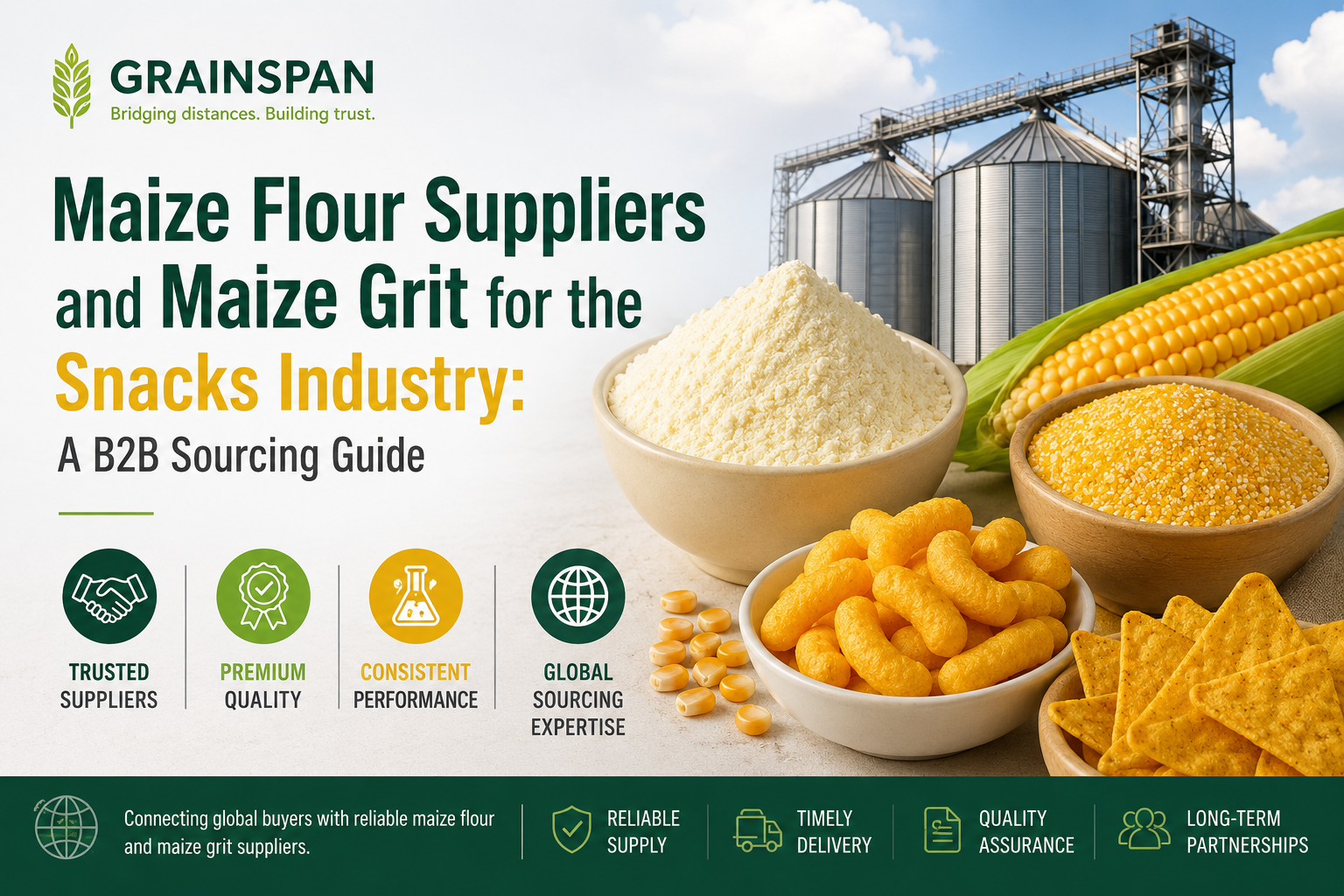
Maize flour and maize grits are two of the most widely used raw materials in food processing globally – and demand for both has grown steadily as snack manufacturers, breakfast cereal producers, and gluten-free food brands scale up their operations. For B2B buyers across Asia, the Middle East, and Africa, finding reliable maize flour suppliers who can deliver consistent quality at commercial volumes is a recurring challenge. This guide covers what to look for in a bulk maize flour supplier, how maize grit is used in the snacks industry, the case for gluten-free maize flour, and how GrainSpan Nutrients serves industrial and export buyers from our corn dry-milling plants in India.
Looking for bulk maize flour or yellow maize grits? Contact GrainSpan Nutrients for product specifications, certifications, and a pricing quote.
What Are Maize Flour and Maize Grits?
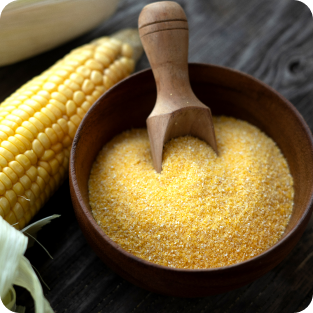
Maize flour and maize grits both come from dry-milled corn, but differ in particle size and application. Maize grits are coarsely broken endosperm particles, screened to specific size ranges – typically between 1.0 mm and 3.5 mm. Maize flour is milled finer, usually below 150-200 microns, and is used where a smooth texture or fine coating is required.
The key quality decision in corn dry milling is whether to degerm the kernel before milling. Degermed maize flour has the germ (the fat-rich embryo) removed before grinding. This reduces fat content from around 4-5% to below 1%, which significantly improves shelf life and reduces rancidity risk – critical for industrial buyers who hold stock or ship product over long distances. Degermed yellow maize grits and maize flour are the standard specification for most commercial food applications.
What to Look for in a Maize Flour Supplier
When evaluating maize flour suppliers for B2B supply, the following factors determine whether a supplier can perform reliably at commercial scale:
- Moisture specification: Food-grade maize flour should be supplied at maximum 12-13% moisture. Higher moisture accelerates microbial growth and shortens shelf life. Always confirm the target moisture and testing method.
- Particle size consistency: For batter coatings, the D50 and maximum coarse fraction matter for coating adhesion and texture uniformity. For extruded snack applications, grits need tight size screening. Ask for a particle size distribution report, not just a nominal grade name.
- Degerming quality: Expressed as residual fat content or germ separation rate. A well-degermed maize flour runs below 1% fat. Poor degerming means higher fat, faster rancidity, and potential quality issues downstream in your process.
- Mycotoxin compliance: Aflatoxin is the primary concern in corn-derived products. FSSAI limits are 20 ppb for food applications; EU limits are 2 ppb for aflatoxin B1 in food products. Confirm the supplier’s testing protocol – frequency, method (ELISA vs HPLC), and action thresholds.
- FSSAI and ISO certifications: A minimum for domestic supply and most export markets. ISO 22000 or FSSC 22000 is increasingly required by large food manufacturers and FMCG groups in their supplier qualification processes.
- Production capacity vs your order size: A supplier whose total installed capacity is close to your monthly requirement has little buffer for demand spikes or production issues. Understand their capacity utilisation before committing.
Applications of Maize Grit in the Snacks Industry
Maize grit for the snacks industry is one of the most important applications for corn dry millers in India. Yellow maize grits with consistent particle size, low moisture, and controlled fat content are the base ingredient for a wide range of snack formats.
Extruded Snacks
Corn extruded snacks – puffs, rings, tubes, and corn curls – are produced by cooking maize grits under high pressure in an extruder, which gelatinises the starch and forces the mass through a shaped die. The expansion ratio, texture, and crunch of the final product depend heavily on the grits specification: particle size distribution, starch content, and moisture at the extruder inlet. Maize grits manufacturers supplying the extruded snack segment work closely with snack producers to tune their grit specification to the customer’s extruder type and product target.
Corn Flakes and Breakfast Cereals
Large coarse grits (sometimes called brewers’ grits or flaking grits) are cooked, flaked, and toasted to produce corn flakes. Consistent grit size and starch content determine flake uniformity – a key quality attribute for breakfast cereal manufacturers. Grits too fine produce uneven flakes; too coarse means incomplete gelatinisation in the cooking step.
Nachos, Chips, and Masa-Based Products
Tortilla chips and nachos are traditionally made from masa – nixtamalised corn dough. However, in industrial production at scale, degermed yellow maize grits and maize flour are used as the base for direct-expanded or sheeted chip formats. The appeal is process consistency and supply chain simplicity – nixtamalisation is a batch process with variability; grits-based production is more controllable.
Pellets and Half-Products
Corn pellets (half-products) are partially cooked and dried corn-based shapes that are then fried or air-popped by snack manufacturers to create finished products. Maize grit is the primary input. Pellet manufacturers buying maize grit for snacks need tight control on starch gelatinisation potential and moisture, both of which affect pellet expansion performance.
GrainSpan Nutrients supplies yellow maize grits to extruded snack manufacturers, cereal producers, and pellet manufacturers. Request a sample or product data sheet from our team.
Gluten-Free Maize Flour: Growing Demand and What Suppliers Need to Provide
Corn is naturally gluten-free, which makes maize flour a primary ingredient in the growing gluten-free food segment. The global gluten-free food market size has grown at roughly 9-10% CAGR over the last decade, driven by diagnosed coeliac disease, non-coeliac gluten sensitivity, and a broader health trend toward wheat reduction.
For gluten-free maize flour suppliers, the product itself is not difficult to produce – the challenge is ensuring no cross-contamination with wheat, barley, or rye at any point in the supply chain. Buyers selling into the coeliac market or making gluten-free label claims need:
- Dedicated corn-only processing: The milling plant should not process wheat on any shared line or in the same facility. Confirm this in writing during supplier qualification.
- Gluten testing in the finished product: Testing for gluten (ELISA-based, threshold typically below 20 ppm for Codex Alimentarius gluten-free labelling) should be part of the QC protocol, not just an assumption from raw material origin.
- Supply chain traceability: Corn procurement, storage, transport, and milling records should be available to demonstrate no wheat contact at any stage.
- Relevant market certifications: For supply into EU, US, or Australian markets with gluten-free claims, look for third-party gluten-free certification from accredited bodies in those markets, beyond just FSSAI compliance.
GrainSpan’s corn dry-milling operations are dedicated corn processing facilities with no wheat processing on any line, making our maize flour supply suitable for gluten-free applications. Contact us to discuss your specification and certification requirements.
Maize Flour Suppliers in Asia: Market Overview
India, China, and Thailand are the three largest sources of maize-based products for export within Asia. Each has different competitive characteristics:
- India: Large domestic corn production base (35+ million MT annually), year-round processing capability at integrated dry-milling facilities, competitive ex-factory pricing, and APEDA-registered export capacity. India’s geographic position is advantageous for supply into South Asia (Bangladesh, Nepal, Sri Lanka), Southeast Asia, and the Middle East. Non-GMO corn is the default in India, which matters for buyers in GMO-sensitive markets.
- China: Very large corn production but primarily oriented toward domestic consumption and fuel ethanol. Chinese maize flour and grits exports are smaller relative to production and face trade friction in several markets.
- Thailand: Established exporter of tapioca starch and rice flour, with some corn processing, but on a smaller scale than India for maize flour specifically.
For buyers in Southeast Asia, South Asia, and Africa, India-origin maize flour and grits offer competitive landed cost, relatively short shipping distance, and access to a non-GMO supply. Indian suppliers with APEDA registration and ISO 22000 can meet the documentation requirements of most destination markets.
How to Choose the Right Maize Flour Supplier
Beyond technical specifications, the commercial and operational factors that determine whether a supplier relationship works at scale are:
- Minimum Order Quantity (MOQ): Most bulk maize flour suppliers set MOQs at 20-25 MT for domestic orders and 1 FCL for export. If your requirement is smaller, expect to pay a premium or source through a distributor.
- Delivery timelines: For ex-stock standard grades, 3-7 working days from order confirmation is standard domestically. Custom grades or large orders may need 10-15 days. For export, add container booking and port handling – typically 2-3 weeks from payment to vessel departure.
- Pricing transparency: Maize flour pricing moves with domestic corn procurement costs, which are influenced by harvest seasonality and MSP revisions. A supplier who explains their pricing structure and how they handle cost pass-through is easier to work with long-term than one who just quotes a number without context.
- Sample and trial order process: Any credible bulk supplier will provide a 1-5 kg sample for process trials before a commercial order. If a supplier is reluctant to provide samples, that is worth noting.
- Customer support responsiveness: In B2B supply, problems happen – a batch on the borderline of spec, a delayed truck, a missing document. How quickly and straightforwardly a supplier responds to these situations is the real test of the relationship.
Why Choose GrainSpan Nutrients as Your Maize Flour Supplier
GrainSpan Nutrients operates corn dry-milling facilities in Gujarat and Haryana, producing degermed yellow maize grits and maize flour for food manufacturers, snack producers, FMCG brands, and industrial buyers. Our plants run mechanised degerming and roller milling lines with in-line quality checks and dispatch on confirmed CoA.
Key points for buyers evaluating us as a supplier:
- Non-GMO corn sourcing: We procure non-GMO corn from domestic Indian sources – relevant for buyers in GMO-sensitive markets or with clean-label product positioning.
- FSSAI certification and APEDA registration: Domestic food safety compliance and export clearance in place.
- Gluten-free capable production: Dedicated corn-only processing with no wheat on any shared line.
- Flexible grades: Standard degermed yellow maize grits in fine, medium, and coarse grades; maize flour at standard and custom particle size targets. Pre-gelatinised (alpha) corn flour available on request.
- Multi-plant supply: Gujarat plant serves western India and export via Mundra port; Haryana plant serves northern India buyers.
- Competitive ex-factory pricing: Direct manufacturer supply without trader margin. Volume-based pricing available for buyers committing to monthly volumes.
Contact GrainSpan Nutrients to request a maize flour or maize grit product data sheet, certifications, or a bulk pricing quote. We respond to trade inquiries within 24 hours.
Conclusion
Sourcing the right maize flour supplier or maize grit supplier for industrial and export applications comes down to four things: consistent product quality backed by documented QC, adequate production capacity relative to your order, the right certifications for your market, and a supplier who communicates clearly when issues arise. India has a deep pool of corn dry-milling capacity, and the best suppliers in that pool – those with integrated milling, dedicated quality systems, and export capability – can supply Asia, the Middle East, and Africa competitively on most standard grades.
GrainSpan Nutrients is one of those suppliers. We produce degermed yellow maize grits and maize flour from our Gujarat and Haryana facilities, supply domestic food manufacturers and FMCG brands directly, and export to regional markets via Mundra and other Indian ports. If you are evaluating suppliers for a new or existing requirement, we are ready to discuss your specification.
Ready to source maize flour or maize grits in bulk? Contact GrainSpan Nutrients or download our product specifications to get started.
Frequently Asked Questions
-
What is the difference between maize flour and corn flour?
Maize flour and corn flour are the same product referred to by different names – maize is the term more commonly used in Europe, Asia, and Africa, while corn is the standard term in North America. Both refer to finely milled corn endosperm. In India, both terms are used interchangeably in trade and labelling.
-
Is maize flour naturally gluten-free?
Yes, corn (maize) does not contain gluten. Maize flour produced in a dedicated corn-only facility with no wheat processing on shared equipment is gluten-free and suitable for coeliac and gluten-intolerant consumers. For certified gluten-free labelling, testing for gluten contamination below 20 ppm (Codex Alimentarius threshold) is required, in addition to clean processing conditions.
-
What maize grit size is best for extruded snacks?
The ideal maize grit size for extruded snacks depends on the extruder type and die configuration. For most single-screw extruded snack applications, medium grits in the 0.5-1.5 mm range work well. Twin-screw extruders can handle finer material. Confirm the optimal grit specification with your extruder manufacturer or process technologist, then match that to your supplier’s available grades.
-
What certifications should I look for in a maize flour supplier for export?
For export supply, the minimum certifications to look for are: APEDA registration (required for Indian agricultural exporters), FSSAI license, and ISO 22000 or FSSC 22000 food safety management certification. For GCC markets, Halal certification is required. For EU supply, FSSC 22000 or BRC certification and mycotoxin compliance with EC regulations (2 ppb aflatoxin B1 in food) are needed.
-
Can GrainSpan Nutrients supply non-GMO maize flour for export?
Yes. GrainSpan sources non-GMO corn from Indian domestic origins. India does not commercially cultivate GM corn, so the Indian corn supply is non-GMO by default. For buyers requiring non-GMO documentation for clean-label or regulatory purposes, we can provide a supplier declaration and traceability documentation confirming Indian-origin non-GMO corn as the input material.